
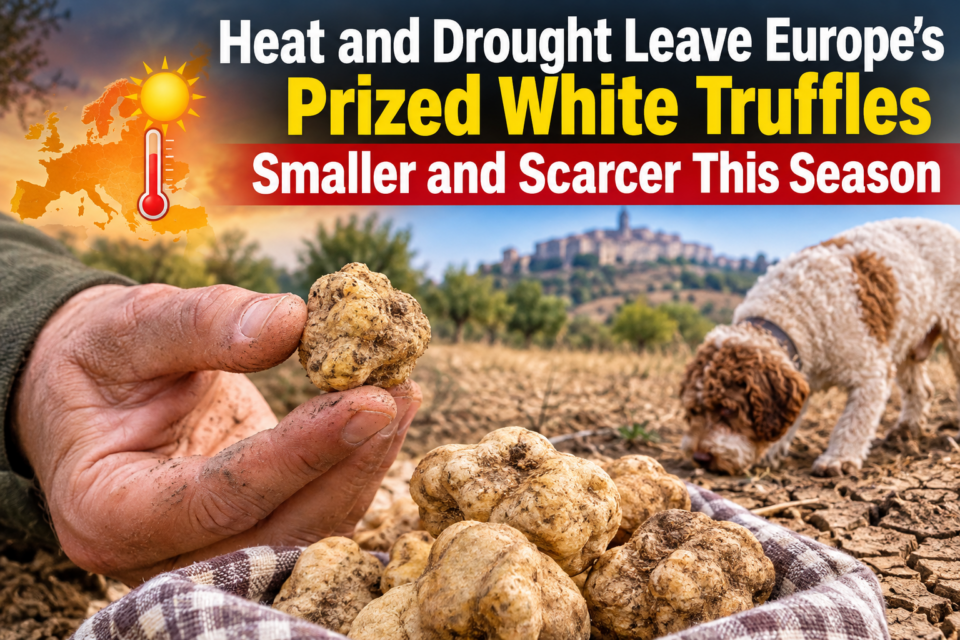
In the misty hills around Alba, in northwest Italy, the white truffle season is under way, and it is not quite the one hunters had hoped for. After months of heat and drought, the prized fungus is turning up smaller and in fewer numbers, a pattern that growers and scientists across southern Europe say is becoming harder to ignore.
A slow start in Piedmont
Truffle hunters in the Alba area, known locally as trifolau, traditionally begin searching on October 1, working with trained dogs in oak, hazel and poplar woods. This year the early weeks were disappointing. Dry, compacted soil limited growth, and the truffles that emerged were smaller than usual, according to people involved in the trade.
Axel Iberti, president of the Alba truffle fair, said the season began slowly after a hot, dry summer. More recent rains have improved matters, helping larger specimens appear, and demand for the delicacy remains strong. With supply tighter, prices have stayed high. The white truffle can reach as much as €4,000 per kilogram, which is part of why it is regarded as one of the world’s most expensive foods.
The truffle’s appeal is easy to understand for anyone who has smelled one. Shaved over pasta, eggs or risotto, a few slivers can transform a dish, and chefs often treat it as a signature of the autumn menu. That makes any change in supply visible quickly, from restaurant menus to specialty retailers.
Why white truffles are so sensitive
Unlike black truffles, which can be grown in managed plantations, the white truffle has largely resisted cultivation. It lives in a delicate partnership with the roots of particular trees and thrives in cool, moist soil. Heat and prolonged dry spells disrupt that relationship, reducing both quantity and quality.
That dependence on wild forests is what makes the species vulnerable. When conditions change, the fungus cannot simply be moved or replanted, and reliable commercial production remains out of reach despite years of experiments. Traditional knowledge of truffle hunting in Italy was added to UNESCO’s list of intangible cultural heritage in 2021, a recognition of how deeply the practice is tied to local life.
A similar story in Croatia
The same warning signs appear across the Adriatic. In oak forests outside Zagreb, truffle hunter Petar Alebic says each year for the past seven or eight has been worse than the one before. He estimates this season’s harvest is about 30% below normal, and he has begun to supplement his income by leading truffle-hunting tours for visitors.
Scientists studying the fungus in Croatia describe a broader decline. Researcher Mesic says drought, low rainfall and high temperatures have a significant effect on both the amount and the quality of truffles, and that the geographical area where white truffles grow is shrinking along with yields. Taken together, the accounts from Italy and Croatia point to a gradual shift rather than a one-off bad season.
Reasons for cautious optimism
Not everyone believes the white truffle is heading toward disappearance. Experts in Piedmont reject the idea that the species is doomed, and local officials, researchers and hunters are testing ways to protect it. These include forest restoration and reforestation, along with experiments aimed at improving soil moisture in truffle habitats. The thinking is simple: if the trees and the soil can be kept healthy, the fungus has a better chance of surviving a warmer climate.
Hunters also stress stewardship. Some describe caring for the woods as a long-term commitment, because the habitat that produces truffles takes years to protect and cannot be rebuilt quickly. Others are diversifying, turning to tourism and tasting events to reduce their reliance on an unpredictable harvest.
What it means for food lovers
For diners, the impact is likely to be felt in price and availability rather than in sudden disappearance. Restaurants may use truffle more sparingly, and retailers may sell smaller pieces at premium prices. Anyone buying fresh truffles should be wary of unusually cheap offers, since quality and provenance matter, and should buy from reputable suppliers who can explain where their product comes from.
There is also a larger point. The white truffle is one of many foods whose future depends on stable weather and healthy ecosystems. Its story is a reminder that climate change does not only affect distant ice caps or coastlines. It can change what ends up on a plate in a restaurant in Milan, London or New York.
As the season continues through the autumn and into winter, rainfall in the coming weeks will help decide how the harvest ultimately turns out. For the trifolau and their dogs, the work goes on, one muddy hillside at a time.
