
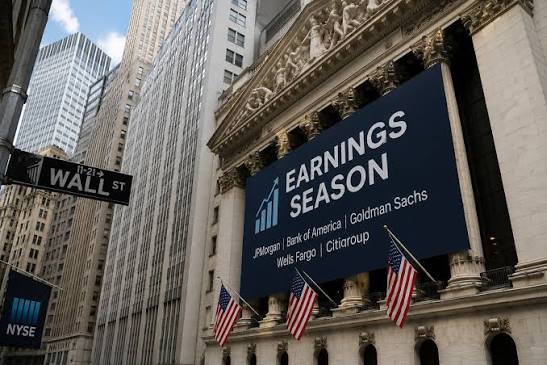
Wall Street’s biggest banks begin reporting third-quarter results today, giving investors their first broad look at how lenders have fared through a period of rising Treasury yields, elevated oil prices and renewed worries about Federal Reserve policy.
Six banks, two days
JPMorgan Chase, Goldman Sachs, Citigroup and Wells Fargo are scheduled to report today, before the market opens. Morgan Stanley and Bank of America follow on Wednesday. The results set the tone for the rest of the earnings season.
What analysts expect from JPMorgan
JPMorgan, the largest US bank by assets, is the main event. Analysts surveyed by LSEG expect earnings of $5.90 per share on revenue of $51.22 billion. A year earlier it earned $5.07 a share on revenue of $47.12 billion, and net interest income is forecast to rise about 12% to $26.84 billion
Analysts will also look at the businesses that swing the quarter. StreetAccount forecasts investment banking fees of $3.02 billion, fixed income trading revenue of $5.95 billion and equities trading revenue of $4.43 billion.
Management guidance matters as much as the quarter itself. JPMorgan’s 2026 outlook points to about $96.5 billion in net interest income excluding markets, adjusted expenses of roughly $107.5 billion and a credit-card charge-off rate near 3.2%. Any change to those numbers, or early guidance for 2027, could move the shares.
A tough record on earnings day
Beating forecasts has not guaranteed a rising share price. JPMorgan has topped earnings estimates in most recent quarters, yet its shares fell after four of the last five releases. Options markets imply a move of about 3.3% in either direction by Friday, compared with an average of 2.6% on recent earnings days.
Citigroup and Wells Fargo
Citigroup is expected to show the fastest growth. Analysts forecast earnings of $2.66 per share on revenue of $23.7 billion, with earnings growth of about 43%. For Wells Fargo, they expect adjusted earnings of $1.85 per share on revenue of $22.31 billion, with profit growth above 10%.
A strong comparison, and a warning
The banks are measured against a very strong spring. In the second quarter JPMorgan reported a record $21.2 billion profit, up 41%, helped by a surge in equity trading and fees linked to the record SpaceX public offering. Chief executive Jamie Dimon cautioned that such results reflect peak conditions rather than a sustainable baseline. Citigroup earned $5.8 billion in that quarter, up 45%, and Wells Fargo earned $6.4 billion, up 17%.
A harder backdrop for dealmaking
The third quarter was less friendly to investment banks. Global investment banking revenue fell 6.6% from a year earlier to $27.2 billion, because of fewer completed mergers and lower debt issuance, according to Dealogic. Rising yields have also made public listings harder. Smart ring maker Oura shelved a planned $2.2 billion public offering last month, citing uncertainty in the IPO market.
Bank shares have reflected the caution. The S&P 500 Banks Index fell 5.4% in the third quarter, while the broader S&P 500 gained about 2.3%.
Why higher rates cut both ways
Rising rates generally help banks earn more on loans, but they can also raise deposit costs and strain borrowers. The Federal Reserve lifted its target range to 3.75%–4.00% in September, its first hike since 2023. Investors will listen closely for evidence on credit quality, especially in consumer lending, and for any change in how customers are using their deposits.
What to watch
The numbers to watch are net interest income, fee income from deals, trading revenue, and the amount banks set aside for bad loans. Commentary on the economy from executives will carry weight, because banks see consumer and corporate spending in real time. With US inflation data due Wednesday and the Fed meeting later this month, the read-through to the wider market could be significant.
