
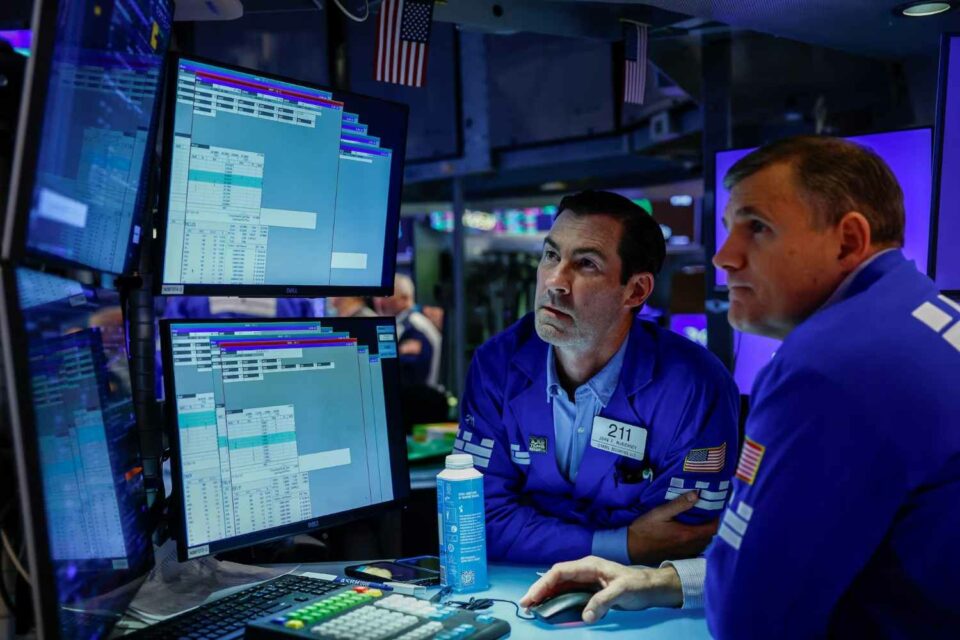
US stocks ended Monday little changed as investors moved money out of technology shares and into more traditional blue-chip names. That left the S&P 500 within sight of its record high while bond yields stayed near 20-year highs, with big-bank earnings and an inflation report due this week.
A flat index hiding a split market
The Nasdaq Composite fell 0.49% on Monday while the Dow Jones Industrial Average rose about a third of a percent, leaving the S&P 500 down by less than a tenth of a percent. The flat headline figure masked a clear divide. Large technology stocks weighed on the broader index while industrials and financials advanced.
The S&P 500 spent the session in negative territory and never turned positive, though buyers stepped in late. For investors who simply hold an index fund, it was an uneventful day. Underneath, however, money was shifting between sectors.
Close to a record, but narrow
The S&P 500 is not far from its peak. It posted its first close above 7,800 last Monday, finishing at a record 7,818.93, while the Nasdaq Composite also closed at a record 27,599.79.
The rest of the week was choppier. On Thursday, the S&P 500 fell 0.47% to 7,765.36 and the Nasdaq dropped 1.25%, as technology shares lost 2.09%. On Friday the S&P 500 recovered 0.59% to 7,811.54 and the Nasdaq added 0.64%.
Market breadth, the number of stocks driving gains, has been a worry. As of last Monday, an equal-weighted version of the S&P 500 had fallen 3.6% over the previous month while the standard index rose 0.7%, a sign that a small group of large companies was doing most of the work. Analysts at Equity Clock noted that benchmarks were testing all-time highs with poor breadth, and warned of a potentially volatile mid-October.
Friday’s telecom shock
Friday’s session produced some of the sharpest single-stock moves of the week. T-Mobile fell 13.27% to $148.58, AT&T lost 9.81% and Verizon dropped 8.75%, making telecom the weakest group. At the other end of the board, Novavax rose 15.8% and Moderna gained 14.21%.
Rates and oil set the backdrop
Two forces continue to shape sentiment. The 10-year Treasury yield held at 5.24% on Friday. At that level, bonds offer real competition to shares. Oil is the other: Brent crude settled at $104.72 on Friday. Energy was the best-performing sector on Thursday, rising 2.34%.
Concerns about artificial intelligence spending have added to the pressure on technology shares. One market report this month described a Nasdaq slump on AI revenue fears, with Nvidia sliding.
Even so, investors do not appear panicked. The VIX, Wall Street’s main measure of expected volatility, fell to 14.84 on Friday. That is a relatively calm reading given the moves in oil and bonds.
What comes next
The calendar is busy. JPMorgan Chase, Goldman Sachs, Citigroup and Wells Fargo report today, followed by Morgan Stanley and Bank of America on Wednesday. US consumer price inflation data is due on Wednesday. The Federal Reserve meets on 27 and 28 October.
If the bank results show resilient lending and trading, they could support the argument that the economy is holding up despite higher rates. A hot inflation reading would do the opposite, reinforcing expectations of further tightening and putting valuations under more pressure.
For now, the market is being driven less by a single story than by the balance between earnings, oil and bond yields. Investors who see the index flat should look beneath it.

1 comment
[…] Next Article […]