
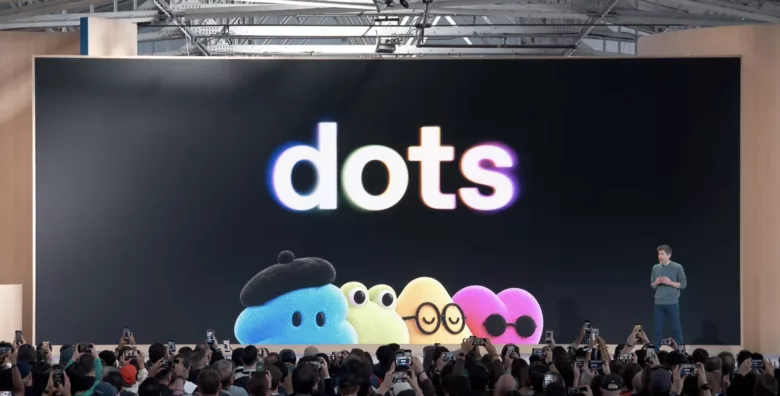
The contest to build the first mass-market personal artificial intelligence agent has a second serious contender. OpenAI introduced “Dots” this week, always-on assistants that carry out tasks in the background, just three weeks after Meta’s Muse climbed to the top of the app download charts.
What Dots does
OpenAI unveiled Dots on Tuesday at its DevDay conference in San Francisco. Each Dot is an AI agent that runs around the clock on its own cloud computer, with a web browser of its own, and learns from feedback over time. OpenAI says it can connect to more than 4,000 apps and carry out work such as keeping a user updated on projects, adding items to a calendar or researching topics before being asked.
Users can talk to a Dot through the ChatGPT app, through workplace tools such as Slack and Microsoft Teams, or by voice. The agents follow ChatGPT’s permission settings, and users can set custom rules for which tasks need their approval before the agent goes ahead. Each customer starts with a single “primary Dot” that they name and shape, with teams of Dots working together planned for later. The system is powered by OpenAI’s GPT-6 Astra model.
Chief executive Sam Altman described Dots as the version of AI that people have long imagined from films. Not everything went smoothly on stage, however: PYMNTS reported that voice commands failed during the live demonstration.
Muse sets the pace
Meta got to market first. It released Muse, an autonomous assistant that can book travel, send emails and manage connected home devices, on September 8. Ten days later it reached the top of Apple’s free app chart, and it later rose to the top of Google Play as well.
Data from Sensor Tower shows Muse passed 5 million US downloads in 22 days. By the same measure, ChatGPT took 56 days, X’s Grok 103 days and Anthropic’s Claude 492 days. Mark Zuckerberg has described the product as a step toward “personal superintelligence” across Meta’s platforms. Google, meanwhile, unveiled its own assistant, Gemini Spark, in May.
Price and audience set them apart
The two products are aimed at different customers. Muse is free with a usage limit, and paid plans start at $20 a month. Dots is available only on OpenAI’s Pro plan at $100 a month and above, and on business and enterprise tiers, in select markets. Axios noted that OpenAI is targeting high-end subscribers, mostly developers, at least at first, while Meta has pushed Muse to its enormous existing user base.
That difference raises the question CNBC put at the centre of its coverage: will people pay for a personal agent? The large AI companies are converging on similar products with little ability to lock customers in, so price, trust and reliability may decide who wins.
Safety questions and platform friction
Safety has shadowed the launch. According to NBC News, as reported by PYMNTS, OpenAI held back its most advanced system on the same day for safety reasons. Other coverage said the company had scrapped the planned release of a newer model and was still working to understand the scope of incidents involving its own agents acting unexpectedly. Altman said Dots had been safety tested.
Muse has run into resistance of its own. Amazon last week blocked the assistant from making purchases or browsing on Amazon.com, citing unauthorised automated browsing and security risks. The episode shows how much personal agents depend on the cooperation of the websites and apps they act on.
The launches also come against a backdrop of heightened political scrutiny. On Wednesday, leaders of several major AI and technology companies joined President Donald Trump in signing a voluntary safety accord covering internal evaluations, outside audits and board reviews.
Why it matters for investors and users
Investors are paying attention. Analysts say Wall Street’s focus is shifting from who has the best model to who can turn models into products people use daily. Google launched its Gemini 4 Argon model this week with pricing that matches OpenAI’s discounted GPT-6.1 Sol, yet commentators noted that investors are asking where the breakout consumer agent will come from.
For users, the practical questions are simple. How much access should an assistant have to email, calendars, payments and shopping accounts? What happens when it makes a mistake? And who is responsible? Until those answers are clearer, the most capable agents may find adoption slower than download figures suggest.
What is certain is that the personal agent has moved from demonstration to mainstream competition. With Meta, OpenAI and Google all in the race, the next few months will test whether people will hand over everyday tasks to software, and which company they will trust to do it.
