
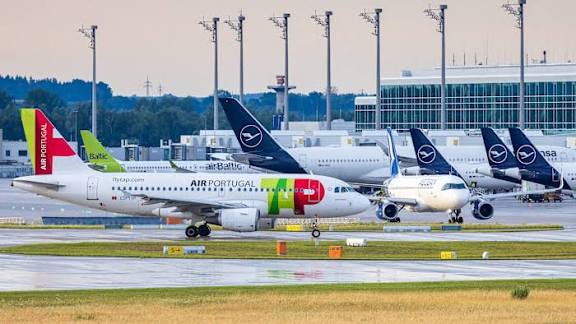
Lufthansa has taken a decisive step toward becoming the owner of Portugal’s national airline. Within a day of winning the first round of TAP Air Portugal’s privatisation, the German group confirmed it is negotiating to buy the rest.
The Portuguese government announced on Wednesday, after its weekly cabinet meeting, that Lufthansa had beaten Air France-KLM to a 44.9% stake in TAP. The first-phase price is roughly €1.2 billion. The state would initially keep 50.1% of the carrier, but Lufthansa would take charge of executive and operational management.
Why Lufthansa won
Prime Minister Luís Montenegro said Lufthansa’s financial offer was 16% higher than its French-Dutch rival’s and carried less uncertainty. Lufthansa’s bid was paid entirely in cash. Air France-KLM had proposed a mix of cash and shares. Under the privatisation decree, the winning bidder may also take up any shares left unsold to employees, which could lift its holding toward 49.9%.
The government says Lufthansa also brought the more ambitious growth plan. It promises to expand TAP’s fleet to 117 aircraft by 2035 and to as many as 130 afterwards, backed by an estimated €3 billion to €4 billion in aircraft investment. Up to eight Airbus A350-900s are due to be transferred to the carrier from 2030. The package also includes €500 million for a pilot training school at Tancos, an innovation centre in Aveiro and a corporate services hub. It comes on top of an investment by Lufthansa Technik in Santa Maria da Feira that had already been announced.
The second phase: the rest of TAP
Lufthansa’s proposal goes further than the minority stake. On Thursday, the group’s chief financial officer confirmed separate talks about acquiring the state’s remaining 50.1%. Under the terms the government has outlined, the sale would take place around mid-2028. Lisbon would receive €1.351 billion, made up of €863 million in cash and a 5% stake in Lufthansa Group valued at €488 million.
That shareholding would make Portugal the second-largest investor in the German group, as Finance Minister Joaquim Miranda Sarmento has noted. He called the opportunity one Portugal cannot afford to miss. Lufthansa chief executive Carsten Spohr described TAP as one of the few large European network carriers still available for consolidation, and a strong fit for his group’s geography. The group expects about €450 million in synergies from the transaction.
A carrier in need of a partner
TAP has been seeking a strategic partner for some time, and its finances help explain why. Portuguese business media report a first-half 2026 loss of €99.2 million, about 40% worse than a year earlier. Portugal has tried to sell the airline before, and earlier efforts failed.
For Lufthansa, TAP’s value lies in Lisbon’s position as a gateway to Brazil and the wider South Atlantic market. The airline would join Swiss, Austrian, Brussels Airlines and ITA Airways in the group, reinforcing its presence in southern Europe.
Politics and labour could complicate the path
The first-stage sale has already cleared its parliamentary hurdle, but the second phase is less certain. The minority centre-right government will need opposition votes again. The Socialist Party has called discussions about full privatisation premature, and the Chega party says it wants to study the terms before deciding whether to back the plan.
Analysts at Bernstein have flagged labour relations as a possible risk. Merging airlines with different pay scales and work rules has often proved difficult. The deal also still requires regulatory approval, including European competition review.
What it means for European aviation
The contest for TAP showed how much value Europe’s largest airline groups place on the few remaining independent flag carriers. Lufthansa has absorbed several in recent years, and Air France-KLM has indicated it wants to grow the same way. Whoever controls the Lisbon hub gains a strong position on routes linking Europe with Latin America.
For Portugal, the question is how much control it is willing to give up in return for fresh capital and a larger network. Parliament’s answer over the coming months will shape the airline’s future and the broader pattern of airline consolidation across the continent.
