
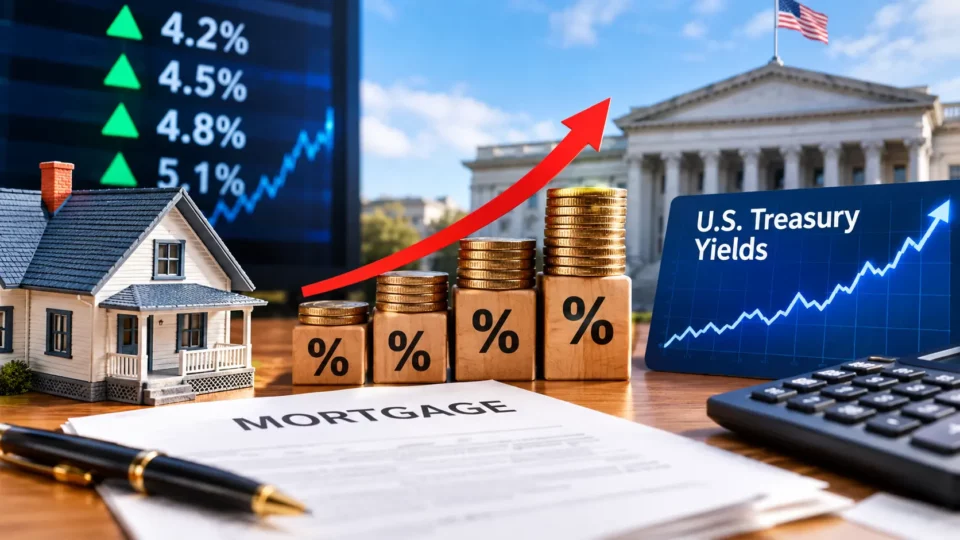
Government bond yields in the United States have climbed to their highest levels in more than two decades, a surge that is already feeding into mortgage quotes, car loans and credit card bills as investors wait for a closely watched jobs report on Friday.
The yield on the 10-year Treasury note, the benchmark that sets the tone for borrowing costs across the economy, reached 5.34% on Thursday, its highest point since 2002. The 30-year bond touched 5.69%. Over the three months that ended Wednesday, the 10-year yield posted its sharpest quarterly rise since 1994.
Why Treasury yields keep climbing
Energy prices sit at the centre of the story. Brent crude futures were trading around $100 a barrel on Thursday, and analysts tie the rise to the wars involving Iran and Ukraine. More expensive fuel pushes up the cost of transport, manufacturing and household budgets. That keeps inflation stubborn and leads bond investors to demand more in return for holding long-dated debt.
The Federal Reserve has moved in the same direction. At its September meeting, policymakers voted 12-0 to raise the benchmark rate by a quarter of a percentage point, to a range of 3.75% to 4.00%, the first increase since 2023. The Fed’s own projections show most officials expecting at least one more rise before the year ends.
Fed Chair Kevin Warsh has described the September move as taking a measure of stimulus out of the system. He has also said that strong economic growth and heavy borrowing linked to the build-out of artificial intelligence infrastructure help explain why long-term yields are rising.
Demand for government debt has not helped. A five-year note auction on September 23 drew weak interest, with indirect bidders, a group that includes overseas central banks, taking 54% of the offering against an average of about 65%. Market pricing for the next Fed move has also been volatile. Earlier this week, futures traders put the odds of an October hike above 70%, according to the CME Group’s FedWatch tool. Those odds have since eased, and investors now see roughly a 60% chance of an increase by early December.
Mortgage rates feel the pressure
For households, the clearest effect is in housing. The average 30-year fixed mortgage rate stood at 7.54% late on Thursday, slightly below Wednesday’s level but close to its highest since the end of 2023. Freddie Mac’s weekly survey, which is measured differently, put the national average at 6.67% in mid-August.
Lenders price home loans off the 10-year yield, so a bond sell-off is passed on quickly. As an illustration, a $400,000 loan repaid over 30 years costs about $2,570 a month in principal and interest at 6.67%. At 7.54%, the same loan costs roughly $2,810, or about $235 more each month. Both figures leave out property taxes and insurance.
Financial stocks have felt the strain too. Shares in Citigroup, PNC and Bank of America fell between 1.4% and 1.9% in early trading on Thursday as inflation worries and the steep rise in interest rates weighed on the sector.
The jobs report is the next test
Attention now turns to the Labor Department’s September employment report, due at 8:30 a.m. Eastern time. Economists polled by Dow Jones expect employers to have added about 84,000 jobs, with unemployment holding at 4.1% for a third straight month. Other forecasts run into the mid-90,000s. August’s gain of 162,000 was a surprise, and Bank of America economists have cautioned that favourable seasonal adjustments may have flattered it.
Payroll processor ADP reported on Wednesday that private employers added 90,000 positions in September, ahead of expectations. Analysts say Friday’s figures are likely to matter less to the Fed’s next decision than the coming inflation readings. Even so, a strong number would strengthen the case for further increases, and a soft one could slow expectations of how quickly the Fed moves.
What it means for borrowers and savers
For anyone planning to borrow, the bond market’s message is that relief is not close. Whether yields have peaked depends largely on oil and inflation, and a settlement of the conflicts that have driven energy costs higher would probably ease pressure on both. Until then, people shopping for a mortgage or refinancing existing debt face some of the most expensive conditions in years.
Savers have a more welcome side to the story, because newly issued long-term government bonds now offer far higher yields than they did earlier this year.
In the sessions ahead, traders will be watching the 10-year yield, which sits just above 5.3%, and crude oil, which remains close to $100 a barrel.
