
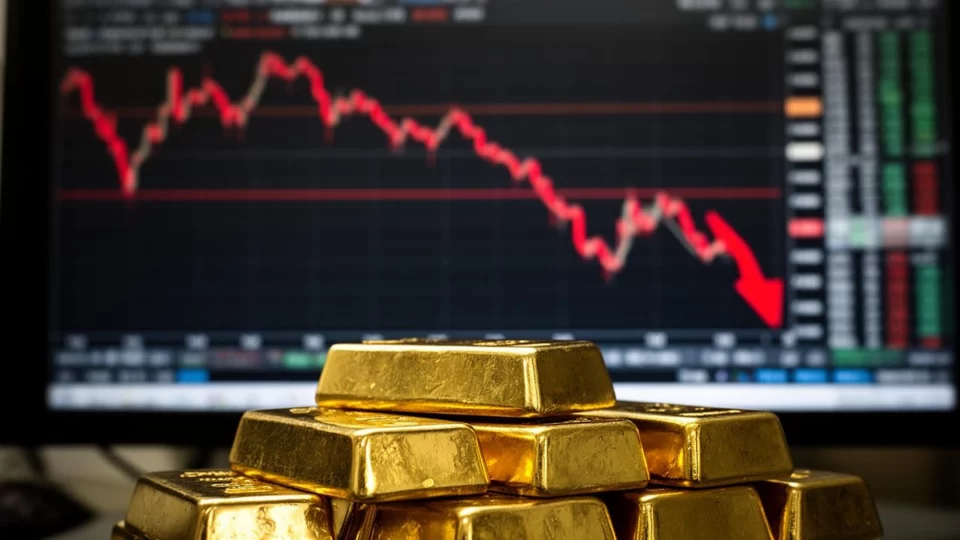
Gold suffered its steepest one-day retreat in weeks on Monday, sliding to a seven-week low as a jump in US government borrowing costs and growing expectations of another Federal Reserve rate increase drained the appeal of a metal that pays no interest.
Spot gold fell between 3% and 4% over the session, depending on the moment measured, and dipped to roughly $4,110 to $4,150 an ounce, its weakest level since early August. In early Asian trading on Tuesday it was hovering near $4,125. Silver also came under heavy pressure.
A bond market at 2007 levels
The catalyst was the Treasury market. The yield on the benchmark 10-year US government note climbed as high as 5.27% on Monday, the highest since June 2007, before easing back to around 5.23%. The 30-year yield pushed above 5.5%, territory it had not visited in more than two decades.
For gold, that is a difficult backdrop. Bullion generates no income, so when safe government bonds offer more, holding the metal becomes more expensive by comparison. One analyst noted that the 10-year note now pays close to 2.9 percentage points a year above inflation. That real return makes it harder to justify sitting in gold.
Rate-hike bets keep building
Traders have grown increasingly convinced that the Federal Reserve will tighten again. According to the CME FedWatch tool, markets now assign about a 70% probability to a quarter-point increase at the central bank’s October meeting. That is up from about 64% a day earlier and 57% a week ago.
Several developments have fed that shift. Fed officials struck a hawkish tone in public remarks last week. A closely followed US business-activity gauge rose to a five-year high of 58.4 in September, suggesting the economy has enough momentum to absorb higher borrowing costs. Energy prices are also climbing again, which complicates the inflation fight.
The oil and Iran connection
That last point ties directly to events in the Gulf. President Donald Trump rejected an Iranian proposal aimed at reopening the Strait of Hormuz. Crude jumped at the start of the week, with US benchmark futures gaining close to 3% at one point before settling back in the low $90s a barrel. Conflicting reports about a possible US-Iran arrangement, followed by official denials, have kept markets on edge.
Higher oil lifts inflation expectations. Higher inflation expectations raise the odds of Fed hikes, and those hikes push up yields and the dollar, which is sitting near a two-month high. Each link in that chain works against gold.
Notably, the metal has gained little from its traditional role as a haven since the conflict began. That is an unusual outcome, and it shows how much interest-rate expectations now dominate pricing.
What analysts are saying
Saxo Bank’s head of commodity strategy said gold’s resilience now faces its most severe challenge so far. He pointed to the surge in real yields, the firmer dollar and the metal’s break below $4,230 an ounce. Analysts at KCM Trade said the combination of high bond yields and high oil prices keeps working against bullion, and warned that hotter inflation or employment data could extend the pressure.
Not everyone expects the damage to last. Veteran gold advocate Peter Schiff argued that the same rise in yields now dragging bullion lower could eventually strain economic growth and government finances in ways that support precious metals over the longer term.
Other assets are under similar strain. Bitcoin has been trading near $83,000 and faces the same macro headwinds, with its next move seen as tied to incoming US data and whether Treasury yields hold above 5%.
A global squeeze on borrowing costs
The pressure is not confined to the United States. Australia’s central bank raised its cash rate on Tuesday, and Japan’s 10-year government bond yield has risen toward 3.1%, its highest since 1996. Together, these moves suggest that upward pressure on borrowing costs is broad-based, not a local quirk of the American market.
What to watch next
Tuesday brings US job-openings figures and a consumer-confidence reading, two data points that could sharpen or soften expectations for October. A strong reading would probably keep yields elevated and gold on the defensive. A weak one could offer bullion a breather.
For individual investors, the episode is a reminder that gold’s price is shaped as much by real interest rates and the dollar as by geopolitical fear. Anyone weighing their exposure should consider their time horizon and speak to a licensed financial adviser. This report is for information only and is not investment advice.

2 comments
[…] Next Article […]
[…] Next Article […]