
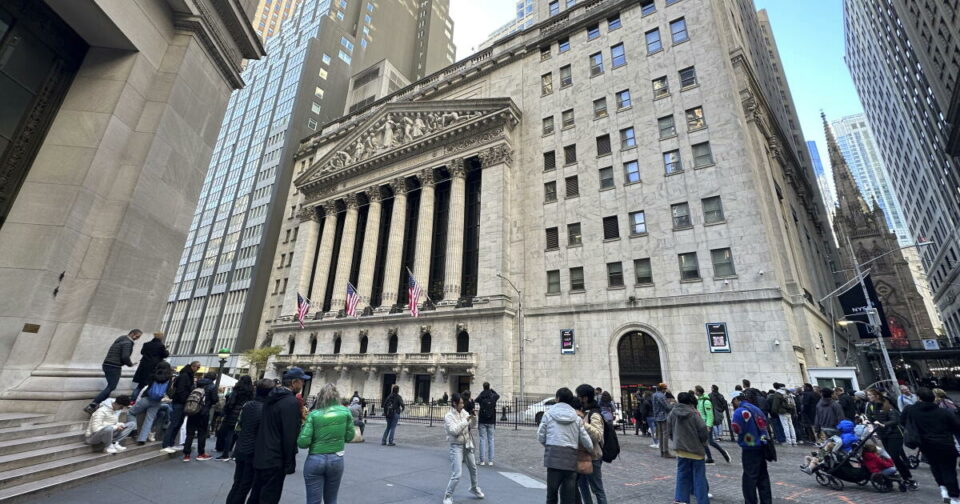
Wall Street ended a subdued session slightly lower on Tuesday as another climb in long-term Treasury yields offset the support of technology heavyweights, leaving investors braced for a crowded run of economic data.
The S&P 500 slipped 12.85 points, or 0.2%, to 7,670.84. The Dow Jones Industrial Average lost 131.59 points, or 0.3%, to 51,349.92, and the Nasdaq Composite fell 22.84 points, or 0.1%, to 26,797.54, according to Associated Press figures.
Bonds set the tone
The bond market, rather than corporate news, drove the day. The 10-year Treasury yield closed near 5.24%, close to the 2007 high of 5.32%, while the 30-year yield sat above 5.5%. Both have climbed steadily since the Federal Reserve raised interest rates this month, its first increase in three years, under Chair Kevin Warsh.
Traders remain convinced that more is to come. Futures markets were pricing about a 70% probability of another quarter-point rise at the Fed’s meeting on 28 October, with a 58% chance of a further move in December, based on CME FedWatch data cited by Schwab.
Some relief arrived late in the session. Market reports said New York Fed President John Williams suggested the central bank could wait until December before raising rates again, which helped stocks pare their earlier losses. Investors also digested data showing US consumer confidence had fallen to its lowest level since 2014.
Tech holds firm, the Dow drags
The market’s split character was on display. Nvidia, the most influential stock in the index, gave up an early gain and finished 0.7% lower. Broadcom rose 1.6%. Energy shares suffered some of the broadest declines, with Exxon Mobil down 0.7%.
Analysts noted that the Nasdaq held almost flat while the Dow did most of the damage, a sign that money is still crowding into a narrow group of large technology stocks rather than spreading across the wider market.
Monday had been rougher. The S&P 500 fell 0.8% to 7,683.69, the Dow lost 0.7% and the Nasdaq dropped 0.9%, with rising yields cited as the main burden.
September’s scorecard
With one trading day left in the month, the S&P 500 is on course for a slight loss in September after a 2.6% gain in August. It remains up 12.1% for the year. The Dow is up 6.8% year to date.
Late September has historically been a volatile stretch for equities, and one widely read technical note pointed to the 7,650 to 7,690 zone as an area of support for the S&P 500 after weeks of sideways trading.
The data that matters today
Wednesday brings a dense calendar. The personal consumption expenditures price index for August, the Fed’s favoured inflation gauge, is expected to show a monthly rise of around 0.4% and an annual rate of 3.7%, matching July. A hotter core reading would strengthen the case for an October hike and could push yields higher again.
Also due are the third estimate of second-quarter US economic growth and the ADP private-sector jobs report. On the corporate side, Micron, Conagra and Levi Strauss are among the companies expected to report earnings. Micron will be closely watched for what it says about demand for memory chips used in artificial intelligence.
Overseas markets
Asian markets were set for a firmer start on Wednesday. Bloomberg reported that equity futures pointed to gains in Japan, South Korea and Taiwan after oil prices fell, easing some pressure as investors tracked developments in the Middle East and the stalemate between Washington and Tehran. A rally in US semiconductor shares was expected to support AI-linked stocks in the region. In India, the Sensex opened about 88 points lower, according to India TV.
What investors are weighing
The central tension is simple. Higher yields make bonds more attractive relative to equities and raise the discount applied to future profits, which particularly affects the fast-growing technology companies that have led the market. At the same time, strong business activity and stubborn inflation give the Fed cover to keep tightening.
Investors will be looking for any sign, in today’s inflation numbers or in the language of Fed officials, that the pace of tightening could ease. Until then, the market looks likely to keep trading in a narrow range, with bond yields setting the direction.

1 comment
[…] Next Article […]