
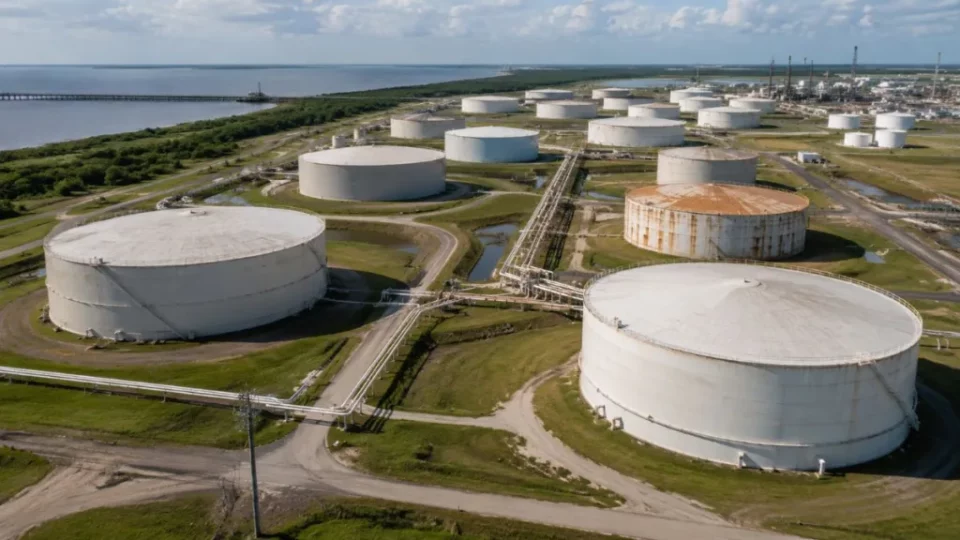
The United States’ emergency oil stockpile has shrunk to its lowest level in more than four decades, a stark measure of how long the Middle East supply shock has lasted and how much of America’s cushion has been spent to soften it.
Department of Energy data show the Strategic Petroleum Reserve fell to 283.8 million barrels in the week to 25 September, the lowest since October 1982, according to Reuters.
Draining a 44-year buffer
The reserve’s decline traces back to the conflict with Iran, which began on 28 February. In March, President Donald Trump ordered the release of 172 million barrels from the stockpile after Tehran closed the Strait of Hormuz, the waterway through which roughly a fifth of the world’s oil consumption normally passes.
The drawdown has been steady. Market commentators noted that the previous week’s figure of 284.6 million barrels marked the 26th consecutive weekly decline, leaving the reserve more than 131 million barrels below its peak.
On Tuesday the Energy Department said it would release up to 40 million additional barrels. It described the batch as the final tranche of the 172 million barrel commitment. According to one account of the announcement, the release will be structured as an exchange, in which companies borrow crude and repay it with interest, with about 200 million barrels expected to flow back into the reserve within roughly a year.
Reuters reported, citing the department, that about 70 million barrels is considered the minimum needed to keep the reserve operationally safe. The stockpile is therefore well above that floor, but analysts say the room for further releases is narrowing.
Prices ease, but the risk premium remains
The headline figures landed on a day when crude was falling. West Texas Intermediate dropped close to 4% on Tuesday to trade below $90 a barrel, while Brent, the international benchmark, hovered roughly between $100 and $104 depending on the time of day.
Traders were weighing several developments. Middle Eastern producers have shown signs of recovering exports, and reports suggest that flows through the Strait of Hormuz have improved considerably since the start of September, with some vessels transiting quietly. Indirect contacts between US and Iranian officials through mediators were also reported on Monday, though no breakthrough has been announced.
Even so, the market has not fully relaxed. Standard Chartered told clients it expects only a gradual and imperfect de-escalation, with periodic flare-ups keeping a premium embedded in prices. The bank sees elevated prices persisting into 2027 and beyond, arguing that the disruption has raised the long-term floor for oil.
What it means for households and the economy
For consumers, the effects are already visible at the pump and the depot. Energy-news reports this week said US diesel prices have topped $6 a gallon, a burden for freight, farming and any business that moves goods by road.
Fuel costs featured heavily in the Conference Board’s latest survey, which found US consumer confidence at its lowest level since 2014, with mentions of oil and gas prices at record highs. They also complicate the Federal Reserve’s task. Inflation has stayed above 3% for most of the year, the Fed has already raised rates this month, and markets are pricing roughly a 70% chance of another increase in October. The central bank’s preferred inflation gauge, for August, is due on Wednesday.
Limited tools in reserve
The Strategic Petroleum Reserve was designed as a buffer against sudden supply interruptions, and for months it has done that job. The concern among energy analysts is what happens if a new disruption arrives before the stockpile has been rebuilt. Some warn that repeated drawdowns risk diminishing returns, and that Washington’s ability to cushion the next shock is weaker than it was at the start of the year.
Political pressure adds another layer. With midterm elections approaching and fuel prices high, policymakers have limited room to manoeuvre. Refilling the reserve would mean buying oil, which could itself push prices up, while continued releases deplete a buffer that cannot easily be replaced.
What to watch next
Three things will shape the outlook in the coming weeks. The first is whether the tentative diplomatic contacts between Washington and Tehran turn into a deal that reopens the Strait of Hormuz on a lasting basis. The second is whether the exchange arrangements return oil to the reserve on the schedule the Energy Department expects. The third is whether energy prices feed into the inflation data that will guide the Fed at its 28 October meeting.
For now, the reserve’s slide to a 44-year low is less a cause for panic than a reminder of how much of the response to this crisis has come from stockpiles built for a rainy day. The rain, as households filling their tanks know, has not yet stopped.
