The Federal Reserve held interest rates steady on Wednesday. A split vote and a change to its meeting calendar showed a central bank still divided over how hard to lean against inflation.
Policymakers left the benchmark federal funds rate at 3.75% to 4.00%, where it has stood since a quarter-point increase in September. Two of the 12 voting members wanted to go further. Governor Lisa Cook and Cleveland Fed President Beth Hammack both voted for another quarter-point rise.
A hawkish hold
The outcome itself was no surprise. Futures markets had put the chance of an increase at under 10% going into the meeting. The 10–2 vote was what drew attention.
Cook’s dissent stood out because governors rarely break ranks, and she had not voted against a decision since joining the board in 2022. Many analysts had expected the hawkish votes to come from regional bank presidents instead. In July, Hammack, Dallas Fed President Lorie Logan and Minneapolis Fed President Neel Kashkari all dissented in favor of a hike, producing a 9–3 vote.
The policy statement kept inflation described as elevated. It also gave a more upbeat view of the economy, saying activity is expanding at a strong pace, a step up from “solid” in September. It dropped the sentence that explained September’s increase. The committee said the accumulation of more information would help it decide the right stance, a signal that it is waiting rather than ruling out action.
“A hold on rates, but not a dovish one,” said David Krakauer of Mercer Advisors, summing up the reaction.
Warsh trims the calendar
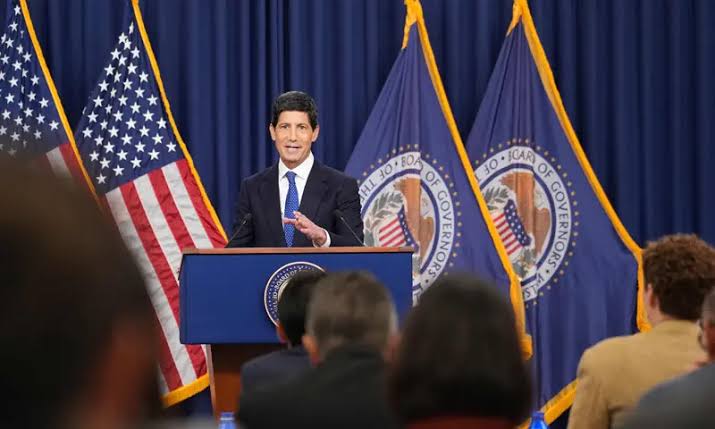
At his press conference, Chair Kevin Warsh announced a change to how often the Fed will decide on rates. In 2027 the committee will still meet eight times, but one of those meetings will carry no vote on interest rates and no post-meeting statement. The number of such “strategy” meetings rises to two in the following year, leaving six scheduled opportunities to change rates outside emergencies.
Warsh said he does not expect rate decisions or statements at the strategy sessions. The change fits his broader approach. He has rejected the forward guidance used by his predecessors and told reporters earlier this month that the Fed will no longer routinely preview its moves.
Politics and the technology build-out
With the US midterm elections six days away, Warsh was asked whether the political calendar influenced the decision. He said politics played no role.
He was also asked about the investment boom in data centers and computing capacity. Higher interest rates, he said, have had an effect on that build-out, though the economy as a whole is growing strongly.
How markets reacted
Stocks edged higher. The S&P 500 gained 0.28% to close at 7,743.98. The Treasury market told a more cautious story. The two-year yield, the most sensitive to Fed policy, fell about 4 basis points to around 4.7%. The ten-year yield rose 5 basis points to roughly 5.04% and the 30-year climbed 6 basis points to about 5.37%. A steeper curve like that often signals that investors expect inflation to stay high over the longer term. The dollar index slipped 0.2%.
What comes next
The next test is today’s release of the personal consumption expenditures price index, the inflation measure the Fed targets at 2%. The European Central Bank announces its decision later today, and the Bank of Japan is expected to hold on Friday.
The Fed’s next meeting is on December 8-9, when new economic projections are due. Market pricing suggests traders see a reasonable chance of a resumed tightening campaign before the year ends. The two dissents suggest that debate on the committee is still open.
For households, a hold means variable-rate borrowing, such as credit cards and home equity lines, does not get more expensive for now. Fixed mortgage rates follow longer-term yields, which rose on Wednesday.
