
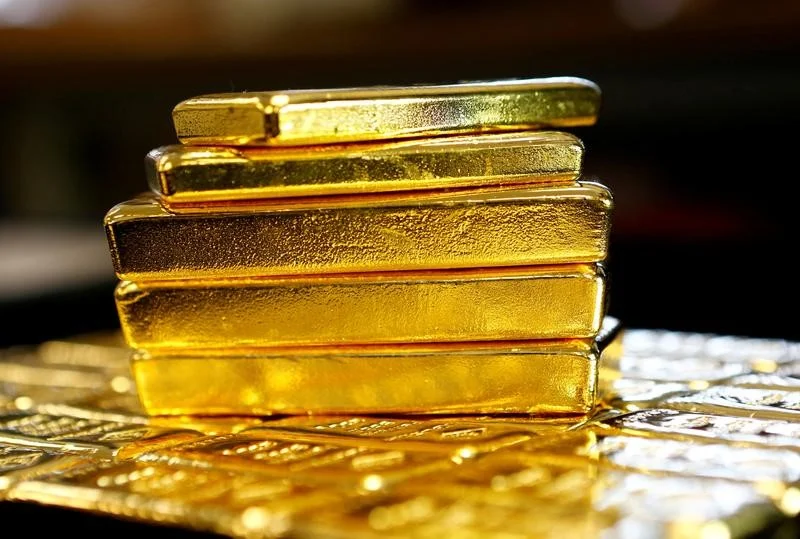
Gold has staged a sharp comeback, climbing back above $4,000 an ounce as a weaker US dollar and falling Treasury yields lifted demand for the metal. The rise of roughly 3% on Wednesday was gold’s biggest one-day gain since mid-August.
A rebound from last week’s low
Spot gold rose to about $4,040 to $4,050 an ounce during the session, touching an intraday high near $4,070. Just days earlier, on October 30, it had slipped to $3,869.85, its lowest level in a year. The bounce therefore recovers most of last week’s weakness. Even so, bullion is still about 2% lower over the past month, though around 1.7% higher than a year ago.
The move was not limited to gold. Other precious metals also advanced strongly, with silver, platinum and palladium all posting gains of 4% or more in some trading, according to market data reported by Reuters.
Why the dollar matters
The main trigger was the currency market. The US dollar fell to a one-month low, and by some measures a five-week low, after the US midterm elections produced a Democratic victory in both chambers of Congress. Gold is priced in dollars, so a weaker greenback makes it cheaper for buyers using euros, rupees, yen or other currencies, which tends to lift demand.
Treasury yields also dropped across the curve. The benchmark 10-year yield briefly slipped to around 4.89%. Falling yields reduce the appeal of bonds relative to gold, which pays no interest. When yields drop, the “cost” of holding a non-yielding asset goes down.
Market analysts offered a straightforward reading. One strategist at American Gold Exchange said a Congress likely to be gridlocked could mean less economic stimulus and a slightly softer outlook for the US economy, which might allow the Federal Reserve to take a gentler approach to interest rates. Others pointed to continued demand for protection against political and geopolitical uncertainty.
The Fed question
Interest rates are the biggest swing factor for gold. The Federal Reserve raised its policy rate in September, and traders still see more tightening ahead. According to CME’s FedWatch tool, markets currently put the chance of another rate hike in December at around 79%.
That backdrop explains why gold has been volatile. Higher rates are usually a headwind for bullion, yet political uncertainty and conflict risk are tailwinds. On Wednesday, the tailwinds won.
Geopolitics also remains in the picture. Talks between Washington and Tehran to end the conflict have not produced a deal, which keeps investors alert to sudden shocks. At the same time, oil prices fell sharply this week on hopes that diplomacy might gain momentum, a shift that tends to ease inflation worries and can influence interest-rate expectations.
What to watch next
All eyes now turn to Friday’s US non-farm payrolls report for October. A strong labour market could reinforce expectations of further rate rises and push the dollar and yields higher, which would probably weigh on gold. A weak report could do the opposite.
Some technical analysts say gold needs to close firmly above the $4,000 level to confirm the rebound, with resistance around $4,200 to $4,230. Others caution that after such a large one-day jump, a pause or partial pullback would not be surprising.
What it means for ordinary investors
For people holding gold, whether as jewellery, coins, exchange-traded funds or sovereign bonds, the latest rally is a reminder of how quickly sentiment can shift. Gold has often acted as a hedge in uncertain times, but it does not move in a straight line, and prices can swing sharply on changes in interest-rate expectations or currency moves.
Financial advisers generally suggest treating gold as one part of a diversified portfolio rather than a bet on short-term moves. In India, where gold is closely tied to household savings and festival buying, a weaker dollar can also affect local prices through the rupee exchange rate. This article is for information only and is not investment advice.
