
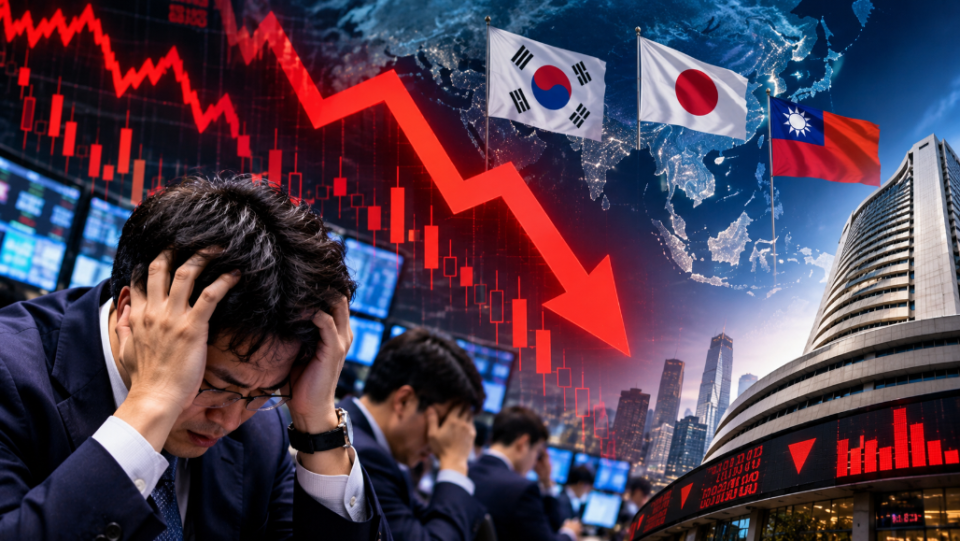
Asian stock markets tumbled on Friday as a rout in artificial intelligence shares that began on Wall Street spread across the region. The slide wiped out the relief traders had enjoyed only a day earlier.
Japan’s Nikkei 225 fell more than 6% at the open and was trading near 57,300 in the morning session. In Seoul, the Kospi dropped as much as 8.8% at one point, triggering a trading halt and briefly sinking below the closely watched 5,000 level, according to Bloomberg. Taiwan’s benchmark was down by more than 8%. Reuters reported that Samsung Electronics lost nearly 10% while SK Hynix shed close to 12%.
A rally erased in a single session
The regional losses followed the sharpest US sell-off in more than a year. On Thursday the S&P 500 fell 4.4% to 7,353.73, its worst day since the “Liberation Day” tariff shock of April 2025. The Nasdaq Composite sank 5.5% to 24,315.00. That left it almost 12% below the record it set last month and well inside correction territory, a term traders use for a drop of 10% or more from a peak. The Dow Jones Industrial Average gave up 1,833 points, or 3.4%, to close at 51,523.06.
The timing made the reversal especially jarring. Only a day earlier the Dow had jumped by more than 1,500 points, its best session since April 2025, as investors digested Tuesday’s midterm elections, in which Democrats made sweeping gains. Thursday’s losses more than cancelled that advance. Reuters estimated that roughly $3 trillion had been erased from the value of S&P 500 companies.
The chip sector bears the brunt
Semiconductor stocks were the epicentre. The Philadelphia Semiconductor Index slumped about 12%, and all 11 sectors of the S&P 500 finished in the red. Wall Street’s “fear gauge,” the VIX, climbed to its highest level since March.
Nvidia, the chipmaker that has become the public face of the AI boom, fell more than 9%. Because of its enormous size, a one-percent move in Nvidia shifts the S&P 500 more than a similar move in almost any other US company, as the Associated Press noted. Advanced Micro Devices tumbled more than 17%, and cloud-computing specialist CoreWeave lost nearly 10%. CNBC calculated that the “Magnificent Seven” group of mega-cap technology firms shed more than $1 trillion in combined market value. Tesla alone dropped about 11%.
Why investors are rattled
Two worries are colliding. The first is political. Democrats are set to take control of key congressional committees in January, and several incoming state governors campaigned on limiting data center construction. Investors fear that the breakneck pace of AI infrastructure spending could slow under tougher scrutiny.
The second is financial. AI-linked shares have swung for months on doubts about whether the vast sums being poured into data centers will earn adequate returns, particularly while borrowing costs stay high. Critics have long argued that prices ran well ahead of profits. Thursday’s rout gave that argument fresh momentum, even though the sector’s defenders point to strong demand and solid results. AMD, for instance, reported better-than-expected quarterly figures this week and said it expects sales to grow 80% next year, yet its shares still fell sharply.
Asia’s exposure
Asian markets are unusually sensitive to this trade. South Korea and Taiwan are home to memory-chip and contract-manufacturing giants that supply the AI industry, and their benchmarks are heavily weighted toward a handful of those companies. When sentiment sours, the effect on the index is outsized. Bloomberg reported that Japan’s Nikkei and Taiwan’s Taiex were on course to enter technical bear markets.
Company news added to the pressure in Tokyo. Toyota fell after reporting lacklustre profits the previous day, and Nintendo also slipped following its results, according to the AP. Australia’s market fared better, losing around 1% in morning trading.
Where money is hiding
Investors looked for shelter. The yen strengthened to a one-week high near 157.40 per dollar, and the Swiss franc firmed. Treasury yields fell as bonds attracted buyers, with the 10-year yield around 4.84%, close to its lowest since early September. European stock futures pointed roughly 1% lower, suggesting the weakness would carry into the continent’s session.
What comes next
Attention now turns to the US jobs report for October, due at 8:30 a.m. Eastern. Economists expect modest hiring, and a surprise in either direction could change how traders read the Federal Reserve’s next move. US stock futures were mixed early Friday. The Nasdaq was heading for a weekly decline of more than 4%, with the S&P 500 down almost 3% for the week.
Not everyone has turned bearish. Some wealth managers described the pullback as a chance to buy memory-chip stocks, arguing that dips tend to reward patient buyers as long as the economy avoids recession. History offers no guarantee. For now, the AI trade, once treated as a one-way bet, has become one of the most volatile positions in global finance.
