
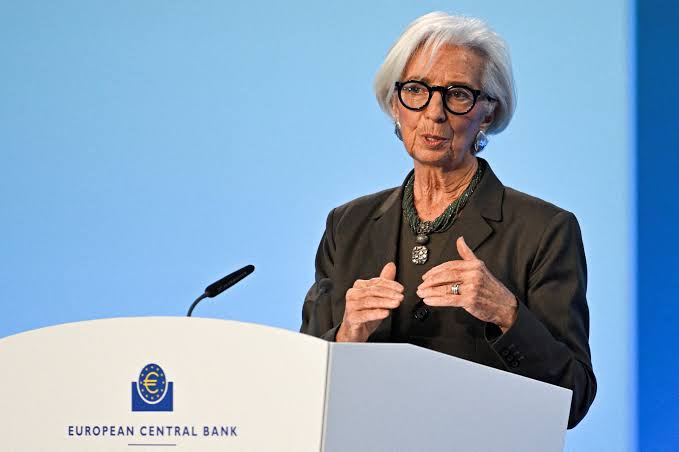
Christine Lagarde will leave the European Central Bank in February, opening a succession battle for one of the world’s most important financial posts at a moment when the bank is deciding whether to raise interest rates again.
The ECB said on Thursday that Lagarde informed its Governing Council and European Council President António Costa that she will step down on February 7, 2027. Her eight-year term was due to end in late October 2027. Council members gave her a standing ovation, the bank said.
Why now
Lagarde, a French lawyer who previously led the International Monetary Fund, took charge of the ECB on November 1, 2019, and was its first female president. She has said she wants more freedom to speak on global issues beyond monetary policy.
The timing has a political dimension. By leaving in February, she gives European leaders time to choose a successor before a French presidential election in 2027. Polls show far-right candidate Marine Le Pen as the favorite, and Lagarde’s early exit avoids a scenario in which a new French government could weigh in on the appointment. Marcel Fratzscher, head of the DIW think tank, said she is showing a strong sense of responsibility towards Europe by giving governments a chance to appoint someone who will protect the ECB’s independence. French President Emmanuel Macron praised her determined leadership and called for an orderly succession.
In September, Lagarde told French newspaper La Croix that she could not rule out leaving a few months before her term expired.
The race to succeed her
Costa said the process to find a successor would begin immediately. The new president will be appointed by the European Council under the EU treaty. Names being mentioned include Klaas Knot, the former head of the Dutch central bank, and Pablo Hernández de Cos, who now leads the Bank for International Settlements.
Leaders will also have to decide on a new chief economist, since Philip Lane’s term ends in June 2027. Berenberg Bank’s chief economist Holger Schmieding expects the posts to be negotiated at an EU summit in December.
Rates held, December in view
Lagarde’s announcement coincided with the ECB’s latest policy decision. The bank left its three main interest rates unchanged, with the deposit rate at 2.5%, after raising them twice this year. It said financing conditions had tightened since its last meeting, which is likely to weigh on inflation and growth, and it did not signal future tightening.
Many economists still expect another increase. Oliver Rakau of Oxford Economics said there is likely a low bar to a December hike, given the likelihood that the bank will raise its inflation forecasts because of higher energy prices. Oil has been trading above $110 a barrel during the Middle East conflict. Standard Chartered has also forecast a December increase.
Markets barely blink
Markets showed little reaction to the resignation news, with some analysts saying the ECB’s reputation will outlive any individual leader. The euro briefly dropped to a 17-month low of $1.1103 after the policy decision, then recovered to about $1.1181 after Lagarde’s press conference.
What it means
The change comes at a delicate moment. Central banks around the world are wrestling with inflation fed by energy prices. The Federal Reserve held rates on Wednesday with two dissents in favor of a hike, and the Bank of Japan held on Friday while saying inflation is at target.
For eurozone households and businesses, the ECB’s decision means variable-rate loans do not get more expensive for now, but the prospect of another rise by December keeps pressure on borrowers. The choice of Lagarde’s successor will shape how the bank handles that balance, and how independent it appears from European politics, through the next decade.
