
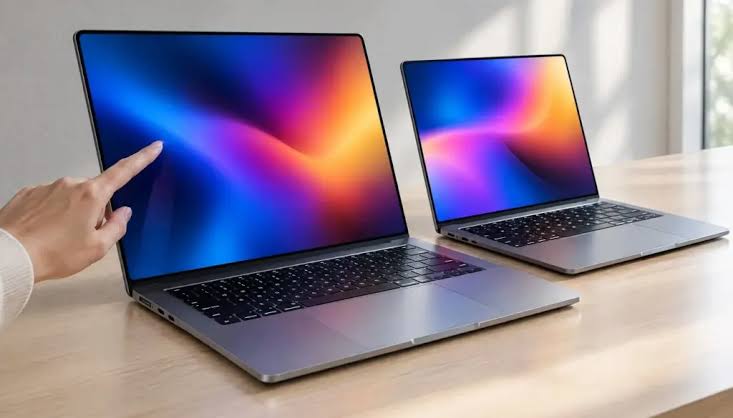
Apple has built a touchscreen into the Mac, ending a design stance it held for more than a decade. At an event in Los Angeles on Wednesday, the company unveiled a MacBook Pro with a touch-enabled OLED display, the first laptop in its range to accept input by finger.
John Ternus, Apple’s chief executive, introduced the machines at an event billed as “Pro and Tell.” They were announced at the end of a week in which Apple released a new OLED iPad mini and updated iMac and MacBook Pro models in staggered announcements.
What Apple announced
The new laptop is officially called the MacBook Pro with PROLED XDR Display. It uses a tandem OLED panel and, for the first time on a Mac, brings the Dynamic Island interface element familiar from the iPhone. The 14-inch and 16-inch models are powered by M5 Pro or M5 Max chips, and every configuration has three Thunderbolt 5 ports. Storage reaches up to 16TB.
Apple said pre-orders open immediately, with deliveries and in-store availability from November 6.
The price
The touchscreen models are significantly more expensive than the MacBook Pros they sit alongside. In the US, the 14-inch model with an M5 Pro chip starts at $2,899 and the 16-inch version at $3,399. M5 Max configurations begin at $4,499 and $4,799 respectively. MacRumors calculated that a fully loaded machine can cost as much as $14,549.
That is about $400 more than the current mini-LED models with the same chips, which start at $2,499 for the 14-inch and $2,999 for the 16-inch. Analysts had expected a price rise. David Naranjo of Counterpoint Research said ahead of the launch that OLED is being used by PC makers as a way to justify higher prices as memory and component costs climb.
A busy week for Apple
The touchscreen MacBook Pro was the finale of a rolling series of announcements:
On Monday, Apple released the iPad mini 8, with an OLED display, an A20 Pro chip and a thinner body that drops from 6.3mm to 5.4mm. It starts at $699, adds IP67 water resistance and Wi-Fi 7, and began pre-orders on Wednesday.
On Tuesday, the company announced an M6 iMac from $1,499 and a 14-inch MacBook Pro with an M6 chip from $1,999. Both kept the starting prices of the models they replace. Apple said the MacBook Pro offers up to 24 hours of battery life and about 30% faster graphics. The iMac comes in seven colors with a 24-inch 4.5K display.
The lineup is something of a puzzle on paper. The base MacBook Pro now uses the newer M6 chip, while the more expensive OLED touchscreen models use the earlier M5 Pro and M5 Max. Early benchmarks of the M6 show faster single-core speeds, but the Pro and Max chips remain stronger in multi-core performance, storage speeds and heavy multitasking.
Why touch matters
Apple’s leaders long argued that touchscreens belong on tablets and that laptops are better served by a trackpad and keyboard. Windows laptops have offered touch for years, and Apple’s decision narrows the gap with its own iPad line.
The open question is how macOS handles it. Reviewers have asked whether the interface needs larger touch targets and new gestures. Some observers also question whether most Mac users will pay the premium for a feature they may rarely use, though artists working with an Apple Pencil are an obvious audience.
What to watch
The launch lands as Apple, like its rivals, faces rising component costs. The company kept prices flat on the M6 machines, but the OLED models show where the premium end of the market is heading. Reviews and early sales after November 6 will show whether buyers accept it.
Apple reports quarterly earnings later this week, and investors will be looking for any sign that the Mac refresh is lifting demand ahead of the holiday season.
