
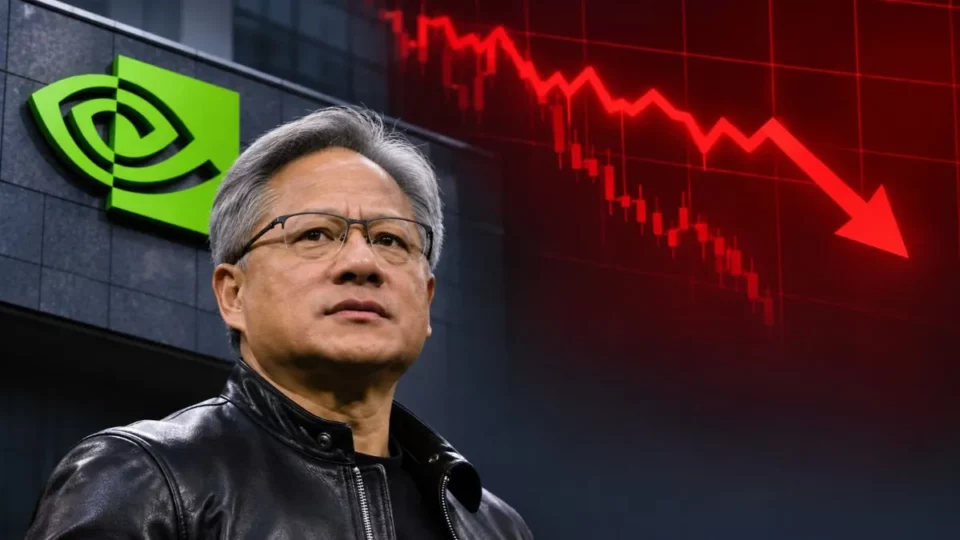
Nvidia has just reported one of the strongest quarters in corporate history, yet its stock is at its lowest level in a year. The gap between the company’s results and its share price shows how much a leadership change and a market-wide sell-off can outweigh even blockbuster sales.
Nvidia shares closed at a 52-week low of about $146 on Thursday, according to market reports. That is roughly 40% below the high of $243.67 reached on 6 October.
Results that beat expectations
On Tuesday, Nvidia reported revenue of $115.8 billion for the quarter that ended 25 October. That was up 20% from the previous quarter and 103% from a year earlier. Data center revenue reached $107.6 billion. Adjusted earnings were $2.68 a share, above analysts’ forecast of about $2.47.
The company guided to revenue of about $130 billion for the current quarter, above the roughly $125 billion analysts expected, according to LSEG. Its cloud revenue backlog now stands at an estimated $2.5 trillion, according to the interim chief executive. Nvidia also raised its share buyback authorisation by $150 billion and said its new Vera Rubin computing platform has begun shipping.
Shares rose after the release, then reversed. They fell 2.9% on Wednesday and have lost more than 13% over the past week.
A leadership change at the top
The reaction cannot be separated from events earlier in the month. On 11 and 12 November, Nvidia announced that founder Jensen Huang had resigned as chief executive and from the board, effective immediately, after reports about his personal relationships. US lawmakers had raised national-security concerns and sought his testimony.
Chief financial officer Colette Kress was named interim chief executive while the board searches for a permanent successor. The earnings report was the first since the change. Board chair Harvey Jones said on the call that Huang will not return.
Analysts have been cautious. HSBC downgraded the stock to Hold, saying the company may struggle until it names a permanent leader. Others have pointed to a possible correction as investors price in uncertainty about strategy, customer relationships and China policy.
A sector under pressure
Nvidia is not the only chip stock under strain. A broad sell-off in artificial-intelligence and semiconductor shares has swept Wall Street and Asia this week. US-listed shares of Taiwan Semiconductor Manufacturing have fallen about 12% in five days, and Taiwan’s stock market had its worst week since 1991.
Companies that depend on Nvidia have also been hit. Cloud providers CoreWeave and Iren fell after the earnings report. The concern is that heavy spending on data centers may not produce returns quickly enough, even though demand for Nvidia’s chips remains strong.
Strong demand, weak sentiment
The numbers present an unusual picture. Revenue has more than doubled in a year. The company is returning large sums to shareholders, and it says demand is still ahead of supply.
Yet the shares are lower because investors are trading on what they cannot yet see: who will lead Nvidia, whether its technical roadmap stays on schedule, and whether customers will keep spending. Rising interest rates have also reduced the value of long-term growth stories across the technology sector.
Kress has said she has high confidence in the team and that the product roadmap is on track. She described the company’s momentum as real.
What comes next
The key event will be the board’s choice of a permanent chief executive. Wall Street has already speculated about candidates, including internal figures with long ties to the company.
Investors will also watch for any further congressional action and for changes in US policy on chip sales to China. A steadier market for technology shares would help, but that may depend on the Federal Reserve and inflation as much as on Nvidia itself.
Share prices and percentage moves in this article are drawn from market reports and may change as trading continues.
