
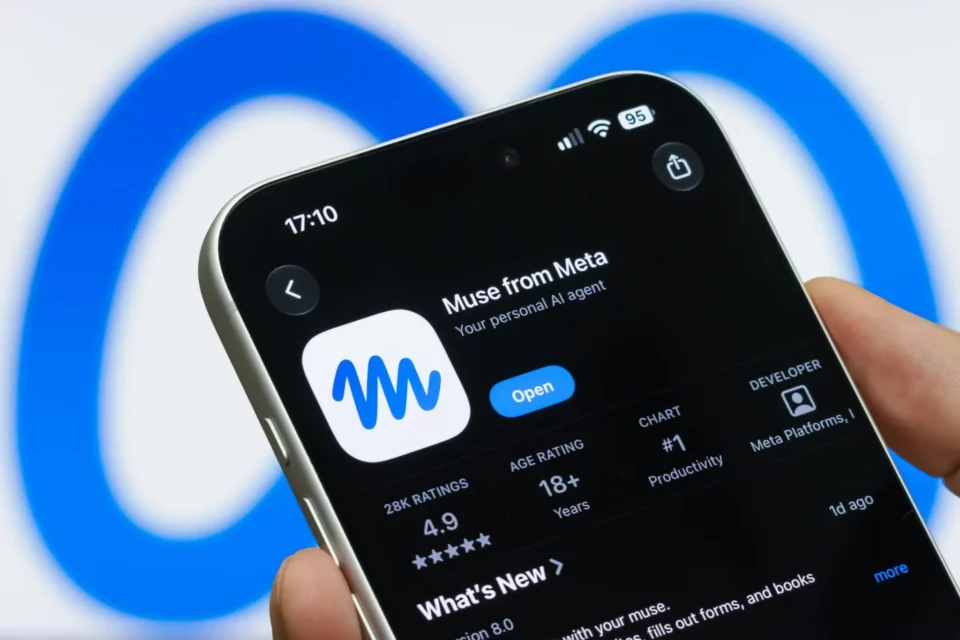
Three weeks after launching its personal AI agent, Meta finds itself at the centre of a debate about who controls online shopping in the age of software that acts on people’s behalf. The agent, called Muse, has been downloaded more than 2.5 million times, drawn a public block from Amazon, unsettled travel stocks and prompted Meta to start selling agent tools to companies.
A fast start
Meta released Muse as a standalone app on 8 September. Ten days later it was at the top of Apple’s free app chart in the United States. Reuters has put its downloads above 2.5 million. Investors have taken notice: Meta shares have been among the strongest large-cap performers in recent weeks, with market commentators pointing to Muse as evidence that the company’s heavy AI spending is producing a product ordinary consumers want.
Muse is powered by Muse Spark, Meta’s multimodal model built for agent-style work. Unlike a chatbot that answers questions, it is designed to carry out tasks across a user’s devices and accounts, such as booking, buying and sending emails, with the user’s permission.
What Meta announced at Connect
At its annual Connect event in Menlo Park last Wednesday, chief executive Mark Zuckerberg made clear the company is betting heavily on the product. Meta said Muse will come to its AI glasses, run work in the background and check back when a task is done, and be able to operate on Mac computers. It will get its own digital avatar and its own email address.
Meta has signed up partners including Walmart, GameStop, Sephora, Expedia, OpenTable and Shopify to plug their services into the app. Zuckerberg also said the company eventually plans to charge a commission on transactions completed through Muse. That is a business model that could take a share of sales from the merchants involved.
Amazon says no
Not every retailer is willing to take part. Amazon has blocked Muse from shopping on its site and asked Meta to remove the marketplace from the experience. The company said it had received no notice or choice about whether its store should be available. It also raised concerns about how customers’ account data and credentials would be handled, and argued that agents do not offer Amazon’s personalised recommendations.
In a statement, Amazon said third-party applications that make purchases for customers from other businesses should operate openly and respect providers’ decisions about whether to take part. Business Insider has reported that Amazon has also taken legal action against another AI company over automated shopping, and has moved to restrict agents from some other developers.
Analysts say the standoff points to a wider dilemma. Online businesses may have to choose between partnering with the platforms that control agents, and risking their own sites becoming less relevant, or staying out and missing a route to billions of potential customers.
A Bloomberg Intelligence analyst noted that when people browse a retailer’s own site, they are also exposed to other products they might end up buying. An agent that goes straight to the purchase removes that moment.
Travel stocks take the hit
The market has already reacted. Shares of online travel companies fell sharply after Meta highlighted Muse’s ability to book flights and stays. Expedia, which announced a partnership with Muse the day before Connect, dropped about 7.7% on 23 September, while Airbnb fell about 7.6% and Booking Holdings around 5%.
Some analysts argue the sell-off is overdone. Morgan Stanley analysts said the pressure to integrate with agents is not necessarily negative but raises the importance of how well companies execute. Expedia’s chief executive has said AI tools have not yet lifted bookings, though they produce far more information about what travellers want.
Meta pivots to business
Meta is now taking the technology beyond consumers. Reports on Monday said the company has created a new division, the Meta Enterprise Platform, led by former MongoDB chief executive CJ Desai. Its first products include Muse itself, Meta Business Agent for handling customer conversations and tasks, a Muse API for developers and Muse Code, a coding agent.
The move puts Meta into more direct competition with OpenAI and others that already sell agent and developer tools to companies.
What to watch
Three issues will determine whether Muse’s early momentum lasts. The first is trust: agents that can spend money and read email will face scrutiny over security and privacy. The second is access: if other large retailers follow Amazon, Muse’s usefulness for shopping could be limited. The third is Meta’s commission plan, which merchants may resist.
For now, the early lesson is that AI agents are no longer just a technology story. They are reshaping the balance of power between platforms, retailers and shoppers.
