
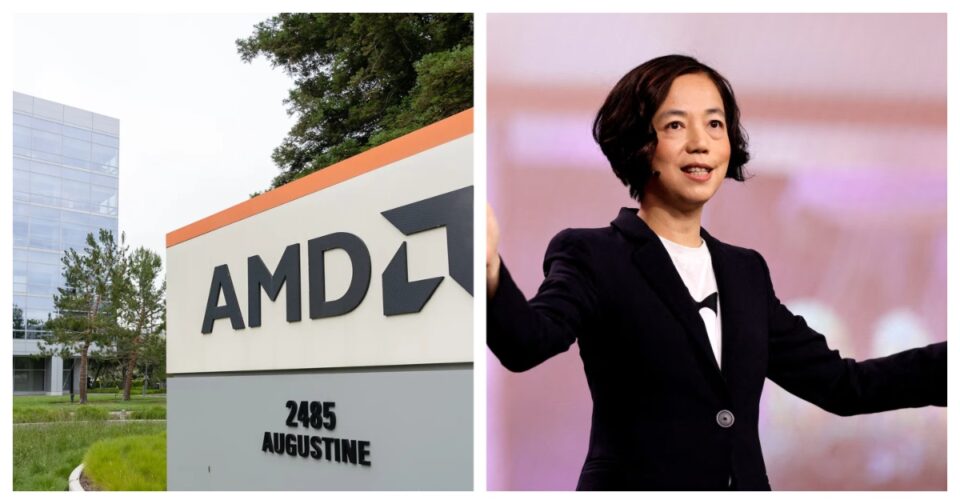
Advanced Micro Devices has agreed to buy World Labs, the artificial-intelligence research company founded by Fei-Fei Li, in an all-stock deal valued at about $8.2 billion. The move brings one of the field’s best-known scientists into the heart of a leading chipmaker.
The company announced the agreement on Monday. Once the transaction closes, Li will join AMD as executive vice-president and chief scientist, reporting directly to chief executive Lisa Su. AMD expects completion by the end of 2026, subject to regulatory approvals and customary conditions.
A deal built on an existing relationship
This is not a cold approach. About seven months ago, AMD backed a $1 billion funding round for the San Francisco start-up at a valuation of $5 billion, with rival Nvidia also taking part. The purchase price is therefore a substantial step up, and it hands Nvidia, as an early investor, a sizeable paper gain.
Because payment is in shares, the number of AMD shares to be issued is not yet fixed. According to a regulatory filing, it will be calculated from AMD’s average trading price over the ten trading days before closing. The agreement itself was signed on 26 September.
The acquisition is AMD’s second-largest on record, behind its roughly $50 billion purchase of Xilinx in 2022.
What World Labs actually builds
Founded in 2024, World Labs develops what researchers call spatial-intelligence models, or “world models”. These are systems that can generate, reconstruct and simulate interactive three-dimensional environments from text, images and video.
In a demonstration earlier this year, Li and Su showed a model called Marble building a 3D scene from only a few images. More recently, the company introduced Atlas, an architecture designed to predict new camera views from flat, two-dimensional pictures.
The potential uses reach well beyond graphics. Li has said interest in Atlas has come from robotics developers building training environments, from the entertainment industry, from therapy-scene generation, and from real estate, design and construction firms that want realistic digital reconstructions of physical spaces. World Labs has also acquired a company called SceniX to develop simulation technology for robots.
Li is best known as the creator of ImageNet, the image dataset that helped launch the modern era of deep learning. She previously held a chief scientist role at Google Cloud.
Why a chipmaker wants a model lab
AMD’s stated reasoning is that understanding how the next generation of AI models will behave should help it design better hardware. By bringing model researchers in-house, the company says it can tie model development more closely to chips, software and full computing systems. It also expects their insight into emerging workloads to influence future product roadmaps.
Su said the combination would help produce the hardware, software and systems that power the next wave of AI, while strengthening what she called the open AI ecosystem.
One market commentator characterised the purchase as a bet on talent and insight rather than an immediate revenue play. AMD gets the people who are building the models its future processors will have to run.
Li, for her part, wrote in a public post that expanding World Labs’ research would now require greater scale, broader reach and tighter integration with computing infrastructure. AMD says the lab will continue its research after closing, and that it will be kept separate from the chipmaking business until the deal is completed.
The wider AI spending backdrop
The deal arrives amid record spending on AI infrastructure. Combined capital expenditure by the largest cloud providers is projected to exceed $1.3 trillion by 2027, and demand for computing power continues to shape strategy across the semiconductor industry. Nvidia, which dominates the market for AI accelerators, announced its own record share-buyback expansion on the same day.
AMD shares were little changed in after-hours trading following the announcement. That muted reaction is not unusual for an all-stock purchase of a private company. Investors are likely to focus on how much dilution the deal creates, how smoothly regulators handle the review, and how quickly AMD can translate research into products customers will buy.
What to watch
Three questions stand out. The first is how the share count settles once the pricing window closes. The second is whether Li’s role gives AMD a stronger voice in setting AI hardware standards. The third is whether other chipmakers respond by buying or partnering with model developers of their own.
For now, the message from AMD is clear. In the race to power artificial intelligence, owning the expertise behind the models may matter almost as much as building the silicon that runs them.

1 comment
[…] AMD to Buy Fei-Fei Li’s World Labs in… […]