
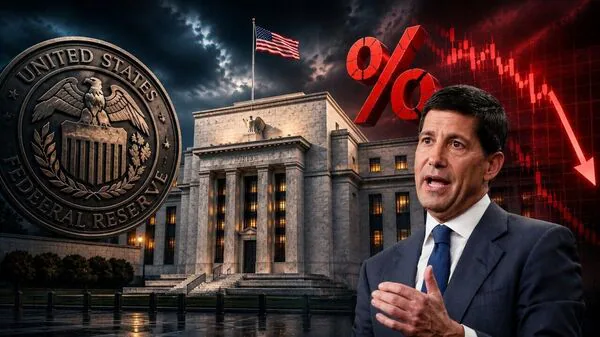
Banks are supposed to be the steady hands in a stormy market. Last week they were swept along with everything else. Shares of the largest US lenders sank alongside the broader sell-off, then bounced on Monday, leaving investors asking a familiar question: how strong are the balance sheets behind the names?
A rough week, then a rebound
JPMorgan Chase fell about 6.1% over the past week to around $317.50, according to a Yahoo Finance analysis published on Tuesday. Bank of America slipped roughly 4% to about $48.08. JPMorgan closed on Tuesday at $317.10, up slightly on the day.
The drop was part of a market-wide rout. Last week the S&P 500 fell about 8.6%, its worst week since April 2025. Large bank stocks also flashed a rare “death cross”, a bearish technical pattern in which a short-term moving average falls below a long-term one. Technical signals of this kind are widely watched, though they are a poor predictor on their own.
On Monday, bank shares bounced as stocks rebounded. In premarket trading Goldman Sachs rose about 3.1% and Truist Financial about 2.9%, recovering part of Friday’s losses.
Rates cut both ways
For lenders, the Federal Reserve is a double-edged force. The central bank’s benchmark rate is in a range of 3.75% to 4.00%, and markets expect a quarter-point increase at the December 8–9 meeting, with talk of a larger move. Higher rates typically widen the gap between what banks earn on loans and pay on deposits, which can lift net interest income.
But there are costs. Higher borrowing costs tend to raise the risk that households and businesses struggle to repay, and they can reduce the value of bonds that banks hold. Mortgage rates have already climbed to 7.28%, according to Freddie Mac’s latest survey, the highest since July, which dampens loan demand in housing. Wednesday’s inflation data will shape how far the Fed goes.
Capital strength under the microscope
In turbulent markets investors tend to scrutinise how much cushion a bank has. One measure is the common equity tier 1 ratio, which compares a bank’s highest-quality capital with its risk-weighted assets. At the end of the third quarter, JPMorgan reported a ratio of 13.9%. Its chief executive has estimated that the bank holds something like $30 billion of excess capital. Bank of America finished at 10.9%, about 90 basis points above its regulatory minimum of 10%.
Profitability tells a similar story. JPMorgan earned a 20% return on tangible common equity last quarter and has a trailing return on equity of about 18%. Bank of America’s trailing return on equity is around 10.7%. Beta, a measure of how closely a stock moves with the market, is about 1.02 for JPMorgan and 1.19 for Bank of America, suggesting the latter tends to swing more.
None of this makes any bank immune to a downturn. But the gap in buffers helps explain why investors treat the sector’s biggest names differently, and why a weak market can punish less well-capitalised lenders more.
The technology test
Capital is only one kind of resilience. On November 16, a software bug at JPMorgan Chase delayed transactions for customers and disrupted payments involving other banks. Chase said it was a technical issue and not a cyber incident, and that customers retained access to their accounts and funds. The episode was one of several major technology outages in the United States this month. It was a reminder that operational reliability is part of a bank’s reputation, and increasingly part of how investors judge risk.
What customers should know
For depositors, the news is largely reassuring. US deposits at federally insured institutions are protected up to $250,000 per depositor, per bank, per ownership category. A share-price slump does not by itself mean a bank is in trouble.
Customers who see unexpected alerts after an outage should be cautious. Security specialists warn that scammers exploit disruptions by sending fake messages. The safest course is to contact the bank through its official app or a phone number printed on a card.
The outlook
The coming weeks hold several tests: the inflation figures, the Fed’s December decision and the path of the wider AI-driven sell-off, which has hurt sentiment across the market. Investors will also be watching credit quality, since a slowing economy combined with higher borrowing costs could push up defaults.
For now, the largest banks look better placed than most to weather the storm. But as last week showed, even the strongest balance sheets can’t shield a share price from a market that is looking for reasons to sell.
