
Governments in Asia are moving to steady jittery stock markets after a global technology selloff. South Korea has said it is ready to deploy its market stabilisation fund, and Taiwan has already put a $15 billion support fund to work.
The measures follow a punishing week for chip and AI-related stocks, which hit Asian exchanges especially hard. The region’s markets are heavily weighted toward the semiconductor companies at the centre of the AI boom.
South Korea prepares
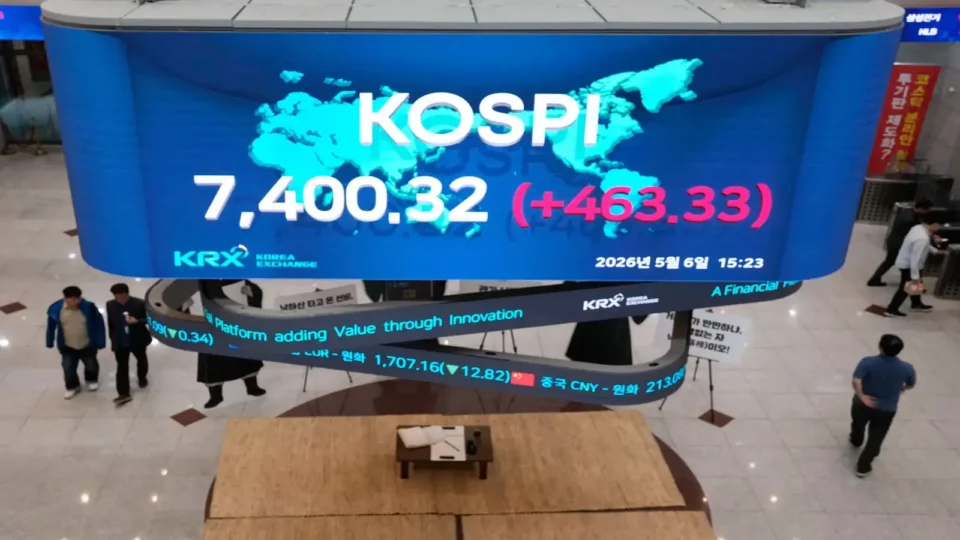
South Korea’s benchmark Kospi index fell more than 5% on Friday to 4,869.96, its lowest close since mid-January and its first finish below 4,900 in about ten months. The index has dropped more than 40% from its June record after doubling in the first half of the year. That rally was led by chipmakers Samsung Electronics and SK Hynix.
On Sunday, the finance ministry held an emergency meeting and said preparations would begin so that stabilisation funds can be activated immediately depending on market conditions. Officials also agreed to loosen limits on daily share buybacks by listed companies for three months, starting Tuesday. They will step up monitoring of leveraged investments and margin calls, and tighten surveillance of illegal short selling for the same period.
Reports from Seoul on Monday put the fund’s potential size at around 11 trillion won. As of early Monday, Reuters described the fund as prepared rather than formally activated. Markets did not wait. The Kospi fell more than 3% on Monday, extending the slide.
Why the fund matters
A stabilisation fund pools money from financial institutions to buy shares, mainly through index-tracking products. The aim is to cushion panic selling. South Korea has set up such funds five times, in 1990, 2003, 2008, 2020 and 2022, but has not deployed one since 2008. During the pandemic, it raised 10.76 trillion won for this purpose.
Analysts say the signal can count for as much as the cash. An economist at Citi Korea said investors abroad have indicated that even a hint the fund could be activated helps discourage short sellers. Pressure is also building at home. Millions of retail investors have been calling for activation, and the main opposition party urged the government to prepare for a “Black Monday” scenario.
One Taiwan-based analyst described the fund as the “last bullet” for Korean authorities, adding that a fall below 5,000 on the Kospi could prompt action. That threshold has now been crossed.
Taiwan acts first
Taiwan moved earlier. Its financial regulators ordered a further tightening of short-selling rules on Saturday, and the finance ministry said its $15 billion stabilisation fund had already entered the market. Taiwanese stocks rose about 2% on Monday, after heading toward their worst week since 1990 at Friday’s close.
Taiwan has used its fund repeatedly since 2000, which allows authorities to signal support without formally declaring a crisis.
What it means for business
Looser buyback limits give companies a way to support their own share prices. They also give executives more room to buy back stock at lower valuations, though companies must still have cash to spend. For businesses that rely on equity markets to raise money, a steadier tape can keep fundraising plans on track.
For investors, the rules on margin and short selling matter because forced selling can feed on itself. When prices drop, leveraged traders are required to sell, which pushes prices lower still. Regulators are trying to cut that chain.
Ripples are being felt elsewhere. The Indian rupee weakened beyond 93 against the US dollar on Monday, and the Sensex gave back early gains. Gold prices in India recovered after shedding as much as 11% in a week, according to Indian media reports.
The limits of intervention
Rescue funds can slow a fall, but they cannot settle the question driving it. Investors are asking whether vast spending on AI infrastructure will pay off. A strategist quoted by Reuters said that without a shift in central-bank policy, traders may find it hard to turn panic into a durable recovery.
That means the next test will come from outside Asia. US inflation data on Wednesday and the reopening of Wall Street after the Thanksgiving break will influence how long any calm lasts. Until the global mood improves, Asian officials are showing they will use every tool short of heavy spending to stop a selloff from turning into a rout.
