
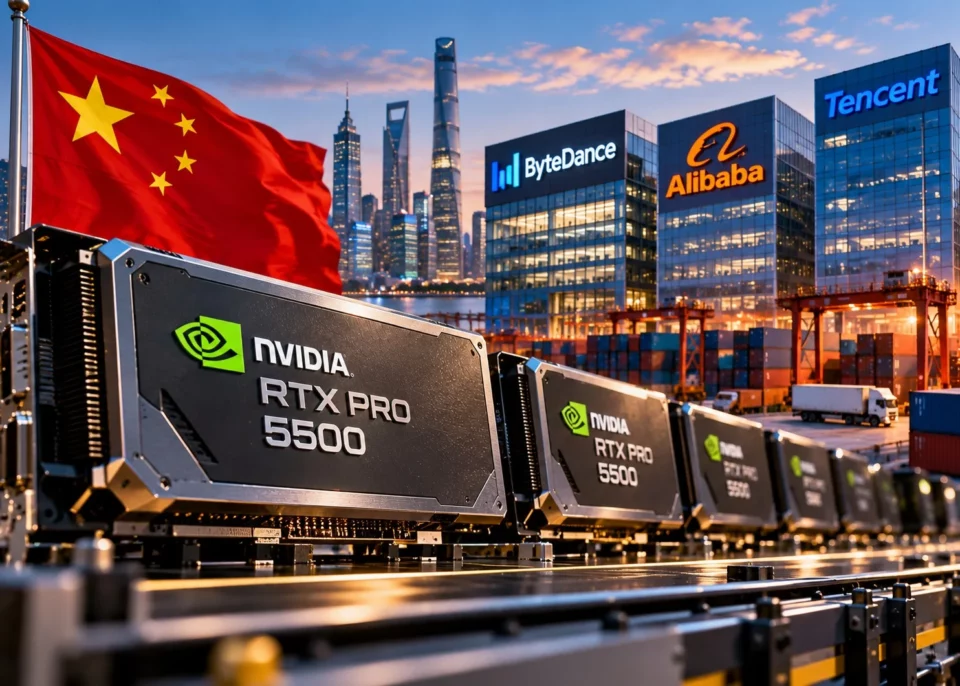
Three of China’s biggest technology companies have placed orders worth more than $35 billion for an Nvidia graphics card built to comply with US export rules, but the chipmaker has warned it will not be able to supply anything close to the full amount.
According to people familiar with the matter, ByteDance, Alibaba and Tencent have together ordered more than 3 million RTX PRO 5500 cards, priced at about $11,400 each. The combined list price exceeds $35 billion, making it one of the largest graphics-card orders reported.
Why this card
Washington’s export controls bar Chinese customers from Nvidia’s most advanced data-centre processors, including its Blackwell B300. The RTX PRO 5500 is a workstation-class card that is less powerful than the H200 and B300 but remains among the most capable Nvidia products Chinese buyers can legally obtain.
The three companies want the cards mainly for inference, the task of running already-trained AI models to produce answers for chatbots and other services, rather than for training new models from scratch.
Inference has become the pressure point because every chatbot reply, video recommendation or AI-generated clip consumes computing power. ByteDance, which owns TikTok and Douyin, Alibaba, and Tencent, which runs WeChat, serve vast user bases, so even modest increases in AI usage translate into large hardware needs.
Buyers had earlier regarded the card as expensive for what it offered and hoped Washington would eventually allow sales of more powerful chips. That the orders have nonetheless reached this scale shows how scarce legal options have become.
A supply gap
The bigger story is arithmetic. Total orders from Chinese customers have exceeded 6 million cards, two sources said, while Nvidia has indicated it can produce no more than 3 million worldwide in 2027.
Nvidia has told customers it cannot guarantee full delivery. Some buyers may receive only 5% to 10% of the volumes they requested, according to reports. Early samples are expected in December, with commercial shipments due to begin in the first quarter of 2027.
Capacity is part of the problem. Starting in 2027, Nvidia is expected to devote much of its manufacturing capacity at Taiwan Semiconductor Manufacturing Co to Rubin, its next-generation platform for large data centres, leaving less room for products such as the RTX PRO 5500.
The $35 billion caveat
The headline figure needs careful reading. It reflects the list price of the cards that were requested, not revenue Nvidia has booked or will necessarily book. Orders can be trimmed, delayed or cancelled, and what Nvidia ultimately earns will track the number of units it can actually build and ship.
In practical terms, a backlog of more than 6 million requested cards against a 3 million-unit ceiling means roughly half of Chinese demand cannot be met even if every unit built goes to China. The true shortfall is larger because the cap covers all markets.
Policy and market backdrop
Earlier reporting indicated that China’s industry ministry had asked firms such as ByteDance and Alibaba to report their procurement plans for the RTX PRO 5500, a move that signalled Beijing’s likely approval. ByteDance alone had reportedly weighed an order of about one million units.
Successive rounds of US restrictions have eroded Nvidia’s once-dominant position in China’s AI data-centre market and opened space for domestic rivals. The latest orders suggest that, for now, many Chinese companies still prefer to buy what they can from Nvidia.
The orders come as Nvidia expands elsewhere. This week it won AI cloud start-up Modal as a customer for its new Vera processors and signed an AI cooperation agreement with Germany covering industrial robotics.
What to watch
Three questions will shape the story. Will Nvidia find a way to raise output beyond 3 million units? Will the December samples arrive on schedule? And will Washington’s position on advanced chip sales change?
For Nvidia, the episode shows that demand for its hardware exceeds what it can make even in a market where its best products are off limits. For Chinese tech groups, the shortfall leaves a choice between waiting in line and leaning harder on domestic processors. For policymakers, it is a reminder that export controls reshape markets in ways that are hard to predict.
