
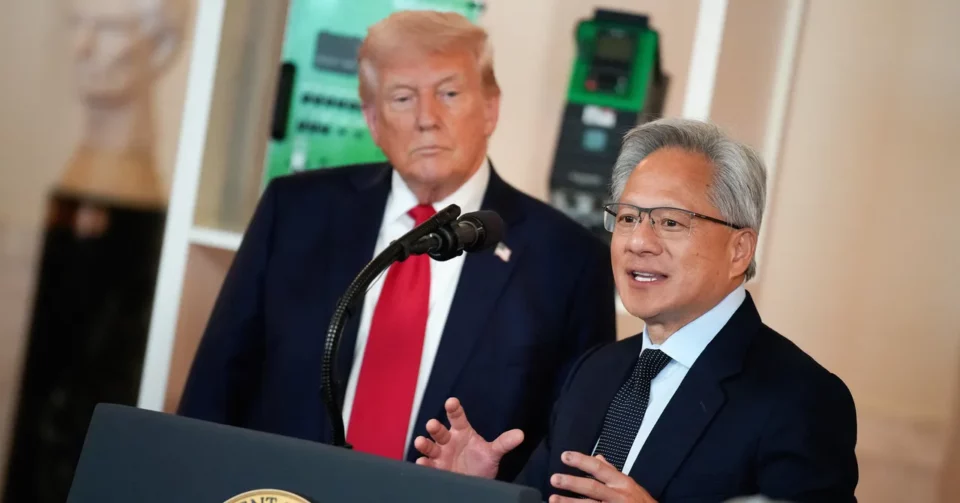
US President Donald Trump has again urged Nvidia’s board to bring back Jensen Huang as chief executive. His call comes as regulators, prosecutors and lawmakers widen their scrutiny of the chipmaker. In a social media post early Monday, Trump said rehiring Huang would be the best outcome for both the company and the United States.
A board that has so far said no
Huang left the top job earlier this month after reports about his personal relationships. One involved a former executive of Singapore-based Megaspeed, once among Nvidia’s largest customers in Southeast Asia. US officials suspect that executive of spying for China, which has denied the claim. Huang acknowledged an extramarital relationship in a statement on 8 November.
Finance chief Colette Kress is now interim chief executive. A person familiar with the board’s thinking told the Associated Press that directors are not currently considering Huang’s return. Treasury Secretary Scott Bessent has reportedly urged the company to look outside for new leadership.
Support for Huang has been loud. An open letter calling for his return has gathered more than 175,000 signatures, and Elon Musk and Epic Games chief Tim Sweeney have backed the idea. Trump’s latest remark follows comments last week in which he said Huang should apologise and be given a second chance.
Regulators close in
The pressure on Nvidia is not only about personalities. On Friday, Reuters reported that Securities and Exchange Commission enforcement staff are examining potential accounting issues at the company, citing two people briefed on the matter. The Wall Street Journal had earlier reported the inquiry without saying what it covered.
Attention has returned to a change Nvidia made last year in how it reports revenue by geography. It switched from customers’ billing addresses to their headquarters locations. At the time, the company said the shift better reflected where its revenue comes from. The SEC declined to comment. Reuters noted that investigations are not evidence of wrongdoing and that many close without action.
Other fronts are open. The Justice Department is reviewing Nvidia’s $12.9 billion deal to buy the open-source platform Hugging Face, alongside a broader antitrust inquiry into its acquisitions. California’s attorney general has also said his office is weighing whether the law and facts justify action.
Investors reacted harshly. Nvidia shares fell 14% on Friday, adding to a rout that has erased well over $2 trillion from its market value since early October.
Export rules and the smuggling question
Washington has also tightened the rules on where advanced chips can go. An interim Commerce Department rule issued on 16 November requires licences for shipments of advanced AI chips to Singapore, Malaysia, Thailand, Indonesia and Brazil. It also covers overseas data centres that rent computing power to Chinese companies. The department said the rule is meant to close a route around existing US limits.
Over the weekend, a Financial Times investigation added fresh detail. It described a network that allegedly moved Nvidia hardware into China through Southeast Asia, using shell companies, gaming businesses and intermediaries. According to the report, some of those intermediaries have alleged links to a sanctioned Cambodian criminal group. Megaspeed has said it conducted lawful business, and the former executive has not been reached by Reuters for comment. US authorities have been investigating Megaspeed since 2024 over possible export-control violations. None of the allegations has been proven in court.
Why it matters beyond one company
Nvidia sits at the centre of the AI boom, so its troubles do not stay inside its own walls. The stock is a heavyweight in index funds and exchange-traded funds, and its slide fed directly into last week’s Wall Street selloff. At the same time, the export questions go to the heart of US-China technology competition. Lawmakers who already wanted tougher limits now have a high-profile case to point to.
Trump’s intervention adds a political layer. Corporate boards usually decide leadership questions on their own, and a public push from the White House is unusual. Whether directors give weight to it, to Bessent’s reported preference for an outsider, or to the signatories of the petition may shape how the company is seen by investors and regulators alike.
What to watch next
Three threads will decide the next chapter. The first is whether the SEC inquiry widens or narrows. The second is how the Commerce Department enforces its new licensing rule. The third is whether the board names a permanent leader, and whether that leader is Huang.
Until those questions are answered, Nvidia faces a period of uncertainty over who runs it, what regulators find, and how much of its business depends on chips that end up where Washington does not want them.
