
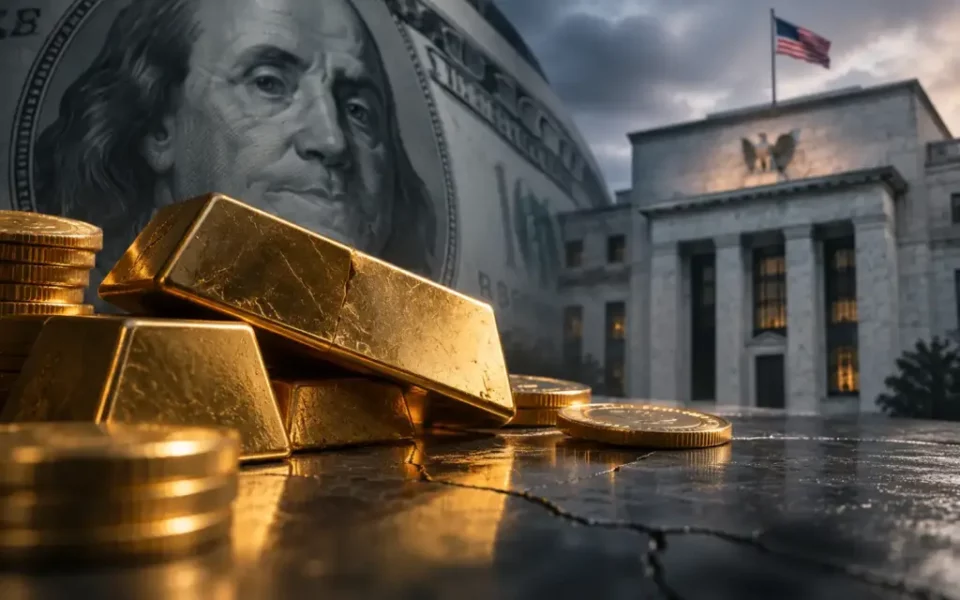
Gold has slid to its weakest level in more than a year. A surging US dollar, bond yields hovering near 5% and a market that now treats another Federal Reserve rate hike as close to certain have squeezed the metal from every side.
Spot gold barely moved early on Tuesday, trading around $3,869 an ounce after touching its lowest level since October 2025 in the previous session. The dollar, meanwhile, climbed to a fresh 19-month peak, which makes bullion priced in dollars more expensive for buyers who hold other currencies.
Why the gold price is under pressure
Gold’s problem is simple arithmetic. It pays no interest, so when rates rise, cash and government bonds start to look better by comparison. Higher rates raise the opportunity cost of holding a non-yielding asset, which cuts into bullion’s appeal.
The latest push came from inflation. Gold lost 4.5% last week after a hotter-than-expected consumer price report. October prices rose 0.4% on the month against a forecast of 0.3%, and the core measure held at 0.3% for a third straight month above expectations. To rate-watchers, that suggests price pressures are proving stickier than hoped.
A December hike moves from possibility to base case
The Fed lifted its benchmark range to 3.75%–4% in September, its first increase since 2023. Few traders now expect it to stop there. CME’s FedWatch tool puts the odds of a quarter-point rise next month at 95.5%, with a 4.5% chance of a half-point move. The central bank meets on 8 and 9 December.
Major banks have adjusted accordingly. Goldman Sachs now anticipates increases in both December and March. Standard Chartered expects hikes in December and the first half of 2027, taking rates to a peak of 4.25% to 4.50%. Earlier this month the 10-year Treasury yield pushed to roughly 5% as traders priced in tighter policy, and other assets that pay no income felt the strain too. Bitcoin sank to nearly a three-month low around the same time.
Is the selloff overdone?
Opinion is divided. Standard Chartered remains positive on bullion over the longer term. The bank is overweight gold with targets of $4,350 over three months and $4,700 over twelve, but it had flagged $3,886 as a key support level. Spot gold has now slipped below that mark, which will test the thesis.
Others are more cautious. One KCM Trade analyst described the metal as fighting a stronger dollar, elevated yields and firm rate-hike expectations, and judged it neutral to mildly bearish at current levels. The logic is that gold is not falling on bad news about the economy. It is falling on the belief that borrowing costs will stay higher for longer.
What to watch this week
Markets are looking for any hint that the hawkish repricing has gone far enough. Investors had been listening for remarks from Fed Chair Kevin Warsh on Monday. Tuesday brings October retail sales and industrial production figures, and minutes from the Fed’s October meeting follow on Wednesday. A weak spending number or cautious language in the minutes could take some pressure off bullion. Strong data would probably reinforce the dollar’s run.
What it means for savers and investors
For everyday savers, the message is mixed. Higher rates tend to lift returns on deposits and short-term bonds, but they also make mortgages, car loans and credit cards more expensive. Investors who hold gold as a hedge against inflation or market stress may find the recent behaviour frustrating. In this stretch, the metal has responded more to interest-rate expectations than to inflation itself.
Anyone thinking of buying the dip, or selling to cut losses, should remember that sharp moves around central-bank meetings are common, and that forecasts, including those from large banks, are not guarantees. This article is for information only and is not financial advice. Readers with specific decisions to make should consult a qualified adviser.
Whatever happens in December, the next few weeks will show whether gold has found a floor or whether the dollar and bond yields have more room to run.
