
People around the world are spending more on feeling well than at any point on record, and the trend shows little sign of slowing. A new report from the Global Wellness Institute (GWI) puts the global wellness economy at $7.5 trillion in 2025, an increase of 8.9 percent from the year before.
The institute’s Global Wellness Economy Monitor 2026, released on Tuesday at the Global Wellness Summit in Phuket, Thailand, projects the market will reach $8.2 trillion by the end of this year. It forecasts the market will approach $11 trillion by 2030, with annual growth of about 7.7 percent, roughly 50 percent faster than the global economy overall.
Putting the number in perspective
The researchers say wellness spending has risen 49 percent since 2019 and is 2.2 times higher than when they first measured it in 2013. By their estimate, the sector is nearly four times the size of the global pharmaceutical industry, which they value at $1.94 trillion. It equals about 61 percent of total global health spending of $12.3 trillion. Wellness made up 6.36 percent of world economic output in 2025, and GWI expects that to reach 7.21 percent by 2030.
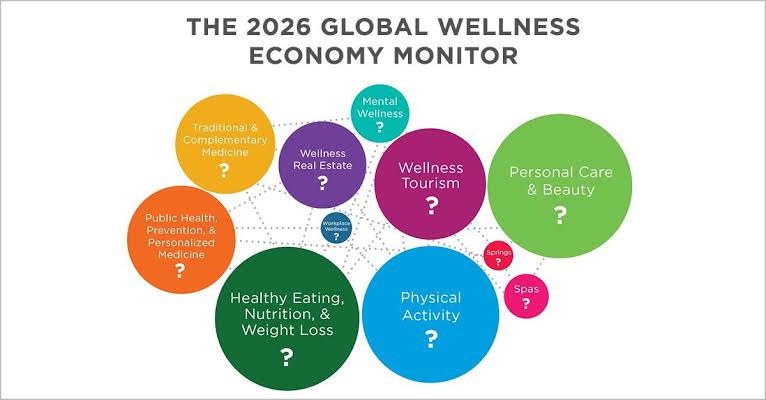
The report covers 11 sectors, including beauty and personal care, physical activity, healthy eating, tourism, spas and complementary medicine. Ten of the 11 grew year on year.
Where the growth is
Wellness real estate is the clear standout. Homes, hotels and communities designed around health have grown to $876 billion, about 3.5 times their 2019 size. GWI expects the sector to double to $1.8 trillion by 2030, which would make it the second-largest wellness market after beauty and personal care.
Mental wellness is the next fastest growing. The sector reached $301 billion in 2025, and its strongest-growing segments since 2019 include meditation and mindfulness, sleep and cannabis. The United States accounts for $139 billion of the total, far ahead of China at $18 billion.
Wellness tourism reached $982 billion, and every region recorded new highs in revenue and trips last year. The United States accounts for 36 percent of spending, but the Middle East and North Africa grew fastest, up 21.5 percent. Separate research released on Tuesday by FINN Partners found that travellers increasingly want active wellness trips rather than traditional spa stays. Nature-based travel led participation at 65 percent, followed by sports-focused travel at 46 percent and retreats at 41 percent.
Movement and medicine. Mindful movement, helped by the Pilates boom, is now a $56 billion market and the fastest-growing segment of physical activity. Personalised medicine, driven by preventive diagnostics and longevity programmes, is valued at $364 billion.
One weak spot
Workplace wellness is the only sector that has stagnated, growing about 1.3 percent a year to $56 billion. The report links this to employers moving toward broader approaches to employee wellbeing, and to the rise of remote and gig work, which leaves more people without workplace benefits.
A gap between regions
Spending per person varies widely. North Americans spend about $6,419 a year on wellness, and Europeans about $2,149. The figure drops to $635 in Latin America and the Caribbean, $527 in Asia-Pacific and $440 in the Middle East and North Africa. GWI also notes that the longevity movement is taking two forms. In the US and other Western countries it is largely sold as a consumer product, while in parts of Asia and the Middle East it is treated as a wider societal and economic priority.
A note of caution
The figures come with some caveats. The report was funded by companies that operate in the sector, including hotel groups, property developers and clinics. Consumer research suggests shoppers want stronger evidence. A McKinsey study published this week found that 40 percent of consumers report unmet needs, especially in longevity, mental health and mobility. About a third of new US consumer goods launches through September carried a health or wellness claim, up from 24 percent in 2021.
GWI researcher Katherine Johnston said the growth reflects structural pressures rather than fashion, pointing to ageing populations, overburdened health systems and rising stress. If that analysis holds, wellness spending may keep rising whether or not any single trend fades.
This article is for general information and is not medical advice.

1 comment
[…] Global Wellness Economy Reaches Record $7.5 Trillion as… […]