
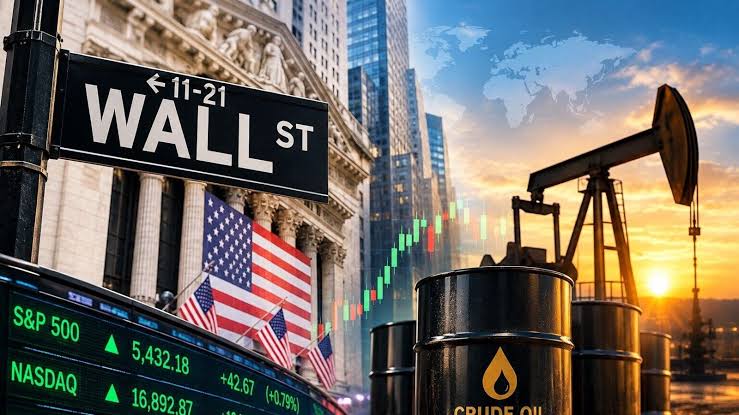
Wall Street staged its strongest session in months on Monday, as a steep fall in oil prices calmed inflation worries and pulled investors back into the stocks they had dumped the week before.
The Dow Jones Industrial Average surged 1,104 points, or 2.15%, to finish at 52,389.75. The S&P 500 rose 2.35% to 7,549.94, and the Nasdaq Composite added 2.74% to close at 25,253.14. Market coverage described it as the S&P 500’s best day since April. Every one of its 11 sectors ended higher, with industrial and consumer discretionary shares each gaining more than 3%.
Cheaper oil does the heavy lifting
Crude was the catalyst. Brent, the global benchmark, dropped 5.8% to $92.57 a barrel. That is a long way below the more than $112 it commanded at the start of November.
The slide followed remarks by President Donald Trump over the weekend that restarting strikes on Iran was very unlikely as long as negotiations show progress. Secretary of State Marco Rubio struck a harder note, describing some of Tehran’s demands for ending the war as unreasonable. Investors chose to focus on the de-escalation signal.
The link between oil and equities is straightforward. Expensive fuel pushes up prices across the economy, which makes it harder for the Federal Reserve to ease policy. When crude falls, that pressure lifts, and richly valued growth stocks, particularly in technology, tend to benefit most.
A rebound after a rough week
Monday’s gains came on the heels of a bruising stretch. The S&P 500 had just posted its biggest weekly decline since April 2025. Democrats’ sweeping midterm election victory had raised fears that tougher regulation could blunt the AI-driven rally that has powered the market for much of the year.
Not everyone accepted that story. Strategists at Morgan Stanley and UBS argued the sell-off in AI stocks had gone too far and that the risk of heavy-handed rules on data-centre development was low. A run of strong profit reports from large US companies added to the improvement in mood. Chipmakers rebounded sharply, with AMD jumping about 13%.
One notable exception
Not every big name joined in. Nvidia, the world’s second most valuable company, closed down 4.27% at $178.67. It had been down as much as 6% earlier in the session, touching its lowest level since March 31. The drop followed its board’s announcement of an independent investigation tied to reports that chief executive Jensen Huang was targeted by a foreign intelligence effort. That the wider market rose so strongly despite a fall in one of its heaviest-weighted stocks shows how broad the rally was.
The inflation test arrives today
Attention now shifts to Washington. The Bureau of Labor Statistics is due to publish the October consumer price index at 8:30 a.m. Eastern time today. Economists surveyed ahead of the release expect prices to have risen 0.3% from September. Core inflation, which strips out food and energy, is forecast to be up 0.2%. That would be a clear step down from September, when headline prices climbed 0.6% and the annual rate reached 3.7%.
This report comes with a quirk. Last year’s government shutdown stopped the agency from collecting a full set of October 2025 data, so there is no comparable base and no annual rate will be published for October. Analysts will have to lean on the month-on-month figures instead.
It is also the last major inflation reading before the Fed meets on 8 and 9 December. The jobs market gives policymakers little reason to panic. Employers added 165,000 positions in October and unemployment edged down to 4.1%. Inflation-adjusted wage growth, however, has been negative, a squeeze households feel at the checkout.
What to watch next
A cooler-than-expected reading would reinforce Monday’s relief. A stubborn core number would put interest-rate worries back at the centre of the conversation. Oil remains the swing factor, and with talks between Washington and Tehran still fragile, crude could reverse as quickly as it fell.
One strong session does not make a trend. After a week of heavy losses, Monday looked more like a recovery than a new chapter, and investors will want to see follow-through before treating it as one. This article is for information only and is not investment advice.

1 comment
[…] Next Article […]