
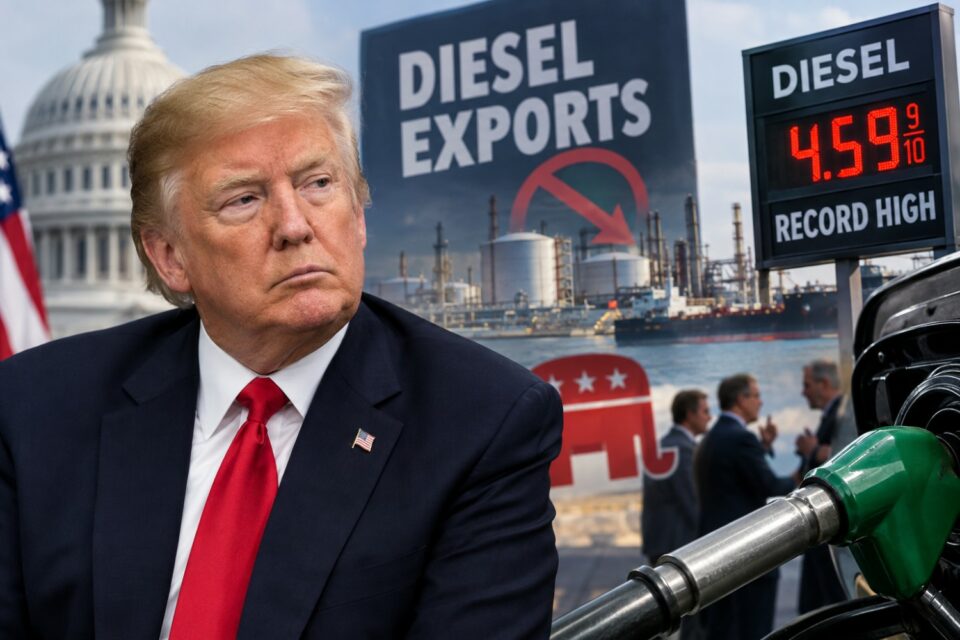
A fight over who gets America’s diesel is intensifying in Washington, pitting farm-state politicians and a president facing midterm elections against an oil industry that says restricting exports would make the shortage worse.
President Donald Trump said on Tuesday that he has argued internally for a ban on US diesel exports as fuel prices hit record levels. “I’ve said let’s not send out the diesel. We make a lot of diesel,” he told reporters on the sidelines of the United Nations General Assembly in New York. Asked when a decision would come, he said it would be made “fast, one way or another”.
Record prices, political pressure
The push follows a sharp run-up in costs. AAA data showed the national average for diesel reached a record $6.53 a gallon on Tuesday, roughly $3 higher than a year earlier. In California, the average stood at $8.44.
Diesel is the lifeblood of farming, trucking and construction, so high prices feed directly into food and freight costs. With November’s midterm elections approaching, Republican lawmakers from agricultural states have been pressing the White House to act.
Senator Chuck Grassley of Iowa said high diesel prices are hurting farmers’ incomes and called for an embargo on exports. Representative Tim Burchett of Tennessee has introduced legislation to ban exports, and Louisiana Governor Jeff Landry, whose state hosts some of the world’s largest refineries, has backed a 90-day ban. Senate Majority Leader John Thune has said he is open to the idea.
The administration hedges
The White House has sent mixed signals. Treasury Secretary Scott Bessent said officials are examining whether a full or partial ban is feasible given the country’s refining capacity. Politico reported that the administration was preparing a plan for a 90-day ban, and shares of major refiners Valero, Marathon Petroleum and Phillips 66 fell on Wednesday.
Energy Secretary Chris Wright, a former oilfield services chief executive, sought to temper expectations. He told The Wall Street Journal that the administration is considering restrictions rather than an outright ban. “We’re trying to avoid a blunt hammer of a government policy,” he said. Earlier, Wright warned that an export ban would mean “more expensive gasoline right away”.
His concern reflects how refineries work. If exports are blocked, storage tanks fill up, and refiners may cut output, including gasoline, which would shrink domestic supply rather than expand it.
Industry pushes back
The Chamber of Commerce and oil industry groups have urged the president to reject a ban, warning it would raise domestic fuel costs. Analysts note the irony. Refiners have been running at record margins because of demand for diesel, and a ban could push them to scale back production, the opposite of what the White House says it wants. Officials have said they support reopening shuttered refineries and expanding capacity, yet no major new US refinery has been built since 1977, and a ban would hardly encourage companies to invest billions in one.
There are also global consequences. Europe is a major buyer of US diesel, and analysts warn that retaliation, including restrictions on gasoline shipments to the United States, could hurt import-dependent regions such as the Northeast.
Some energy analysts argue for less drastic options. One is extending the Jones Act waiver beyond its November 15 expiry. The waiver, which suspends rules requiring US-built and US-crewed ships for domestic cargo, has let more vessels move fuel from the Gulf Coast to California, where refinery closures have created shortfalls.
A limited safety net
The backdrop is the war involving Iran, which has pushed crude above $100 a barrel for much of the past weeks. Brent was trading around $98 to $99 on Tuesday. The US Strategic Petroleum Reserve has been drawn down to 44-year lows, and unlike crude, the United States holds no strategic reserves of gasoline or diesel to cushion a supply shock.
One analyst quoted by Fortune said a ban was a growing possibility but still less than a 50 per cent chance, and suggested the president might talk about it more than he acts.
For now, the decision rests with the White House. Whatever it chooses, farmers, truckers and refiners will be watching closely. So will voters, who see diesel costs at the pump and in the supermarket.
