
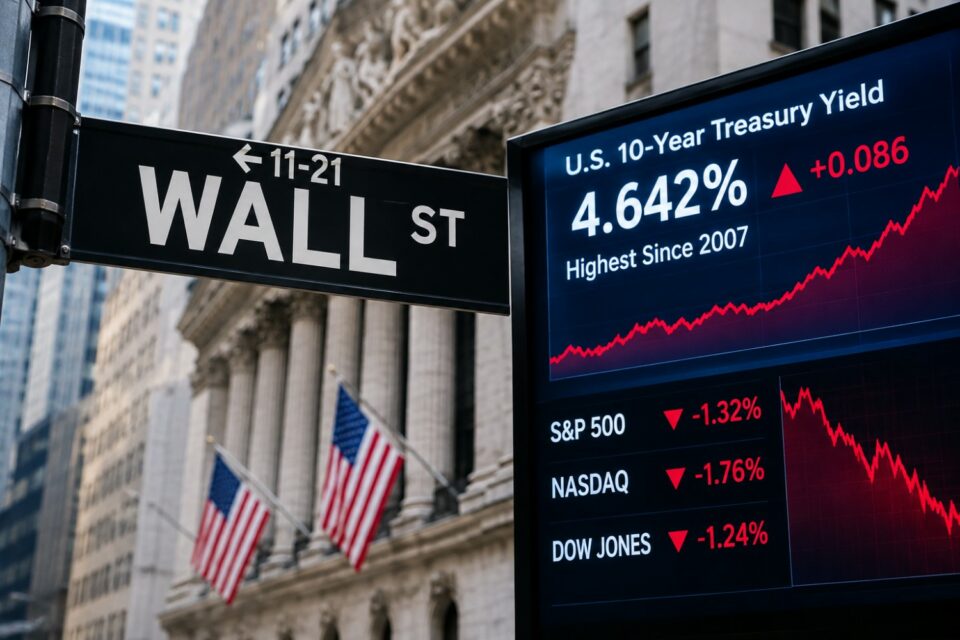
Wall Street stocks fell on Wednesday as a sharp jump in government bond yields rattled investors already nervous about inflation, oil prices and the prospect of more interest rate increases from the Federal Reserve.
The S&P 500 dropped 0.75 per cent to close at 7,706.03, while the Nasdaq Composite shed 1.13 per cent to finish at 26,936.04. The Dow Jones Industrial Average lost 352.10 points, or 0.68 per cent, to settle at 51,511.59.
Bond market takes the lead
The catalyst was not a corporate disappointment but the bond market. The yield on the benchmark 10-year Treasury note rose as high as 5.135 per cent, its highest level since July 2007. It also marked the note’s biggest one-day move since April 7, 2025.
The jump followed purchasing managers’ index readings that came in stronger than economists had expected. Strong activity data can be good news for the economy, but in the current climate it also strengthens the argument that the Federal Reserve will need to keep raising borrowing costs. A weak Treasury auction added to the selling pressure, according to market commentary. Market watchers also noted that the five-year Treasury yield touched 5 per cent, a level it had not reached since 2007.
Higher yields matter to equity investors for a simple reason. They raise the return available from holding government debt, which makes shares look comparatively less attractive, and they push up borrowing costs for companies and households alike.
Where the pain was felt
Utilities and consumer discretionary stocks led the decline, each falling by more than 1 per cent. Both sectors tend to be sensitive to interest rates, the first because of heavy debt loads and the second because shoppers borrow less when credit is expensive.
Among Dow components, McDonald’s fell 4.89 per cent, Alphabet dropped 4.68 per cent and Home Depot lost 2.80 per cent. On the other side of the ledger, Salesforce rose 1.84 per cent, Chevron gained 1.38 per cent and Boeing added 0.95 per cent.
There was one bright spot in the technology sector. Shares of IonQ jumped roughly 12 per cent after the quantum computing company said it had tested what it called the industry’s first real-time quantum error decoder, a tool designed to correct errors without slowing down calculations.
Oil and diplomacy
The bond selloff came a day after a more upbeat session. On Tuesday, the Nasdaq touched an intraday record as falling oil prices eased inflation worries and hopes grew for talks between Washington and Tehran. Brent crude had slipped to around $98 to $99 a barrel, closing below $100 for the first time since early September.
That relief proved short-lived. Oil climbed again on Wednesday, feeding concerns that energy costs will keep inflation elevated. President Donald Trump said US and Iranian officials had held a three-hour meeting on the sidelines of the United Nations General Assembly, describing it as a “very good meeting”, but investors appeared reluctant to bank on a breakthrough.
The Federal Reserve raised its benchmark rate by a quarter of a percentage point last week, and policymakers have signalled more increases may follow. Against that backdrop, any data suggesting the economy is running hot tends to be read by traders as a reason to expect tighter policy.
What to watch next
Asian markets were set to open lower on Thursday, tracking the Wall Street losses. Futures for Hong Kong and Australia pointed down, and the yen, which is near a three-week low, will be in focus as Japanese markets reopen after a holiday. US equity futures were little changed.
The Nasdaq 100 has now retreated from the record high it set earlier in the week, a reminder of how quickly sentiment has swung. Investors will look to weekly US jobless claims figures on Thursday for further clues on the labour market. Attention will also turn to the state visit of Chinese President Xi Jinping to Washington, a meeting that could shape trade and geopolitical expectations in the weeks ahead.
For now, the direction of bond yields, more than corporate earnings, is setting the tone for equities. Until the pace of yield increases slows, analysts say volatility is likely to remain a feature of trading.
