
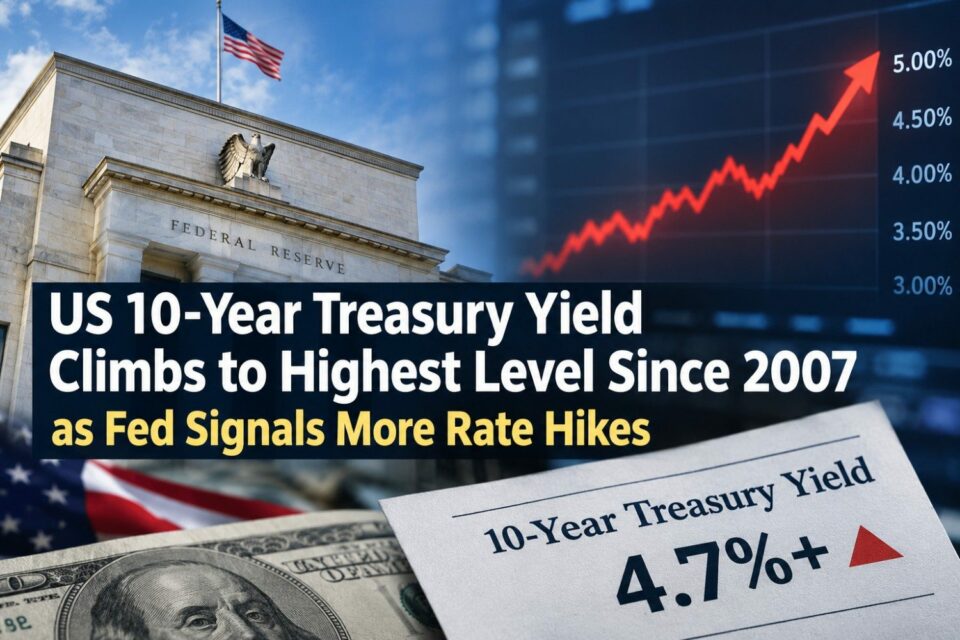
The yield on the benchmark 10-year US Treasury note climbed to about 5.1% on Wednesday. That is a level not seen since July 2007, and it followed a jump of more than 13 basis points in a single session. Investors have concluded that the Federal Reserve is not finished raising interest rates, and the consequences reach well beyond the bond market, from the cost of a home loan to the return on a savings account.
What pushed yields higher
Several forces arrived at once. S&P Global’s flash purchasing managers’ surveys, the earliest monthly read on US business activity, came in well above forecasts, and their price gauges rose to the highest since October 2022. A weak $70 billion sale of five-year notes deepened the losses in Treasuries. Oil added to the pressure. Brent crude settled above $103 a barrel as the US-Iran war continued to stoke fears of sticky inflation.
Fed Governor Michael Barr then gave traders a reason to act. In a speech on Wednesday he described strong growth and a solid labour market, but said inflation remains above the Fed’s 2% target and is not clearly heading back in a timely way. His base case is that further policy adjustments will be needed.
Where the Fed stands
The central bank raised its benchmark rate last week by a quarter of a percentage point to a range of 3.75% to 4.00%, its first increase since 2023. Sixteen of 18 policymakers expect at least one more hike by the end of the year. Markets have moved quickly to price that in. Futures traders now see roughly a 73% chance of an October increase, up from 53% earlier in the day.
Economists are split only on timing. EY-Parthenon chief economist Gregory Daco expects another quarter-point rise in December and warns it could raise the risk of a stock market correction. Tony Miano of Wells Fargo Investment Institute told CNBC the market is signalling a genuine re-tightening cycle, not a one-off insurance move. Behind it all, US inflation was running at 3.4% in the latest monthly reading, well above target.
The ripple effect
The rise was not confined to one part of the curve. The 30-year yield reached its highest since June 2007, and the two-year, which is most sensitive to Fed policy, hit its highest since May 2024. The dollar strengthened, with the euro dropping to its lowest level since late July. Corporate borrowing to fund the artificial intelligence build-out has also added to the supply of bonds competing for investors’ money, according to Yahoo Finance.
What it means for borrowers
The Fed does not set mortgage rates directly. Fixed mortgage rates tend to follow Treasury yields because mortgage-backed securities compete with Treasuries for the same investors. That link is already visible. Freddie Mac’s survey put the average 30-year fixed rate at 6.95% as of 17 September, against 6.26% a year earlier. It was a 19-month high.
For a $400,000 loan, our calculation puts the payment at roughly $2,650 a month in principal and interest at that rate. At 6%, the same loan would cost about $2,398. That is a difference of around $250 a month before taxes and insurance. Heather Long, chief economist at Navy Federal Credit Union, has said the housing market is frozen again with rates back near 7%. Freddie Mac’s next weekly reading is due on Thursday and may not yet reflect Wednesday’s jump. Higher yields can also make car loans and business borrowing more expensive.
Savers and lenders
Not everyone loses. Higher yields tend to lift returns on certificates of deposit, money-market accounts and newly issued Treasury securities. For banks and other lenders, benchmark rates feed through to the pricing of new loans, although how quickly varies by product.
What to watch next
Thursday’s calendar is busy. It includes rate decisions from central banks in Norway, Sweden, Switzerland and Mexico, US jobless claims and Chinese President Xi Jinping’s state visit to Washington. Fed Chair Kevin Warsh has declined to offer guidance on the future path of rates. Until that changes, investors are likely to take their cues from oil prices, inflation data and the next round of Fed speakers. Next Article
