
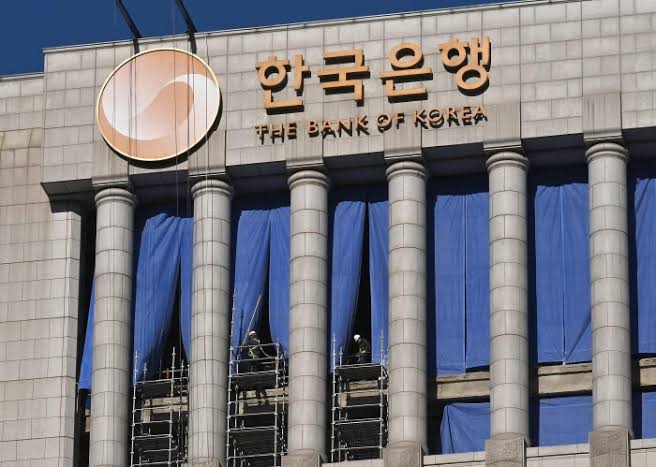
South Korea’s central bank has decided that inflation is still a bigger threat than a slowdown. On Thursday, the Bank of Korea (BOK) raised its benchmark interest rate by a quarter of a percentage point to 3.25%, resuming a tightening cycle that had paused last month.
The new rate is the highest since October 2024. It comes alongside sharply upgraded growth forecasts, as an export boom in semiconductors lifts the economy faster than officials had expected.
A hike with a split vote
The Monetary Policy Board had raised the rate at consecutive meetings in July and August, then held it at 3% in October to assess the effect of those increases. Thursday’s decision, the final meeting of the year, marked a return to tightening.
The decision was not unanimous. Five of the seven board members backed the increase, while two, Hwang Kun-il and Lee Soo-hyung, voted to keep the rate at 3%.
Governor Shin Hyun-song described the move as a preemptive response to inflationary pressures. At a press conference, he said that with growth strengthening further, inflation expected to remain above target for a considerable period and financial stability risks persisting, a 0.25 percentage point rise was appropriate.
Growth forecasts jump
The central bank used the occasion to revise its economic outlook sharply upward. It now expects growth of 3.9% this year, up from 3.3%, and 4.1% in 2027, up from 2.9%. It projects growth of 3% in 2028.
The upgrades reflect strong recent data. Real gross domestic product grew 1% quarter-on-quarter in the third quarter, after 0.6% in the second quarter and 1.8% in the first. Officials credited a surge in chip exports for much of the momentum.
Inflation still above target
Consumer price inflation has eased in recent months, from 3.1% in August to 2.9% in September and 2.8% in October. That is still well above the bank’s 2% target. The central bank forecasts inflation of 2.7% this year, 2.4% next year and 2.1% in 2028.
Reports citing the bank’s own assessment point to energy prices and geopolitical tensions as factors keeping price pressures elevated.
Reading the signals
Analysts are now parsing the language of the decision for clues on what comes next. The central bank removed the word “pace” from its statement on future rate rises, a change that suggests officials will judge the timing of any further increases more cautiously. Governor Shin has left the door open to additional tightening next year, but the two dissenting votes show that the board is not uniformly hawkish.
Some analysts expect the board to temper expectations in the months ahead, either through further dissent in favour of holding rates steady or by fine-tuning its rate projections.
The global context
The Bank of Korea is not acting in a vacuum. Rate increases by other major central banks were among the factors it weighed. In the United States, the Federal Reserve is widely expected to raise rates again in December after hotter-than-expected inflation data this week. If US rates keep rising, the Korean won could come under pressure, raising the cost of imports and complicating the inflation fight at home.
Higher borrowing costs also matter for households. South Korean consumers carry significant debt, and a rising base rate generally feeds through to mortgage and loan rates over time, though the speed depends on how banks price their products.
What it means for the economy
The tension at the heart of the decision is familiar to central bankers everywhere. Growth is robust, which supports tightening, but much of it rests on one sector. A concentrated export boom can deliver strong headline numbers while leaving other parts of the economy, such as small businesses and domestic retailers, less buoyant.
The bank’s challenge in 2027 will be to keep inflation heading toward its target without choking off the recovery or destabilising financial markets. Much will depend on whether chip demand stays strong, how energy prices behave and what the Fed does next.
For now, Seoul’s message is clear. With the economy running ahead of expectations and prices still stubborn, the central bank has chosen to act early rather than wait. Next Article

2 comments
[…] Bank of Korea Raises Rates to 3.25% and… […]
[…] Bank of Korea Raises Rates to 3.25% and… […]