
It was the kind of trading day that tests nerves. On Wednesday, Wall Street slid toward a milestone investors dread, then pulled back sharply, leaving the market calmer on the surface but far from settled.
The Nasdaq 100 briefly fell 20% below its early-October record close during the session, the threshold commonly used to define a bear market. By the closing bell, the index had recovered most of that ground.
How the day unfolded
Selling was heaviest at the open. The Nasdaq Composite fell more than 4% in early trade as chipmakers and other technology names were hit hard. Then buyers stepped in. The Dow Jones Industrial Average erased a loss of more than 1,100 points and finished the session up about 0.33%, while the S&P 500 closed down roughly 0.25% and the Nasdaq Composite ended about 0.62% lower.
Market volatility stayed elevated. The Cboe Volatility Index, often called Wall Street’s fear gauge, rose about 7% to around 28.
What spooked investors
Several worries converged. Doubts over whether the huge spending on artificial intelligence can produce adequate returns have weighed on the sector for weeks. A hot US inflation reading, released the same day, strengthened expectations that the Federal Reserve will raise interest rates in December. New US tariff proposals aimed at 14 trading partners added to the unease.
There is also a political backdrop. Concerns about tougher regulatory scrutiny of the technology sector following the Democratic sweep in the midterm elections have added to the pressure on AI-linked stocks, according to market reports.
Memory and chip companies bore the brunt, with Micron and Sandisk among the notable decliners. A Barclays equity strategist told CNBC that the market appears to be signalling that the AI growth story has hit a wall, and that investors may be bracing for some kind of macroeconomic shock. Others were less dramatic. Charlie Ripley of Allianz Investment Management described the moves as largely sentiment-driven.
A month to forget
Despite the afternoon recovery, the monthly picture is grim. The Nasdaq Composite is down about 7.3% in November, and both it and the S&P 500 are on course for their worst November since 2008. Monday’s powerful rally, which followed Nvidia’s decision to reinstate Chief Executive Jensen Huang, has largely been given back.
Not every part of the market suffered. Investors rotated into sectors such as materials, real estate and energy, and Treasury yields fell as money moved toward bonds. That helped the Dow, which has a lower weighting to the AI leaders, outperform. The gap between the Dow’s gain and the Nasdaq’s loss is a reminder of how concentrated market returns have become in a handful of stocks.
Asia and Europe react
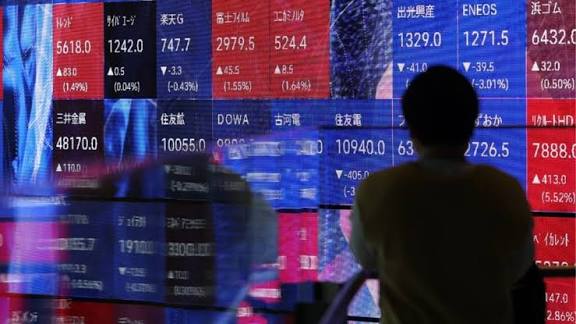
With US exchanges shut on Thursday for the Thanksgiving holiday, attention turned overseas. Asian shares mostly rose as dip-buying lifted sentiment. Hong Kong’s Hang Seng gained about 1.5%, Japan’s Nikkei 225 rose around 0.9% and South Korea’s KOSPI added roughly 0.8%, while China’s Shanghai Composite slipped about 0.5%. South Korea’s central bank, meanwhile, raised its key rate to 3.25%.
European equity futures pointed to a stronger open after the Euro Stoxx 50 closed down about 1.9% on Wednesday.
What investors are watching
The holiday gives traders a pause, but not much clarity. US markets will close early on Friday, which usually means thin volume and the potential for exaggerated moves in either direction.
Three questions will shape the next few weeks. Can chip stocks stabilise now that the bear-market line has been touched and tested? Will further evidence of stubborn inflation push rate expectations higher still? And how will the new tariff proposals, which cannot take effect before late-January hearings, play out in practice?
One analyst quoted after the close said the rebound offers little reassurance that the downtrend has run its course. For now, the Nasdaq 100 has a visible reference point, a line it has brushed once and could revisit, and investors will be watching closely when trading resumes. Next Article
